
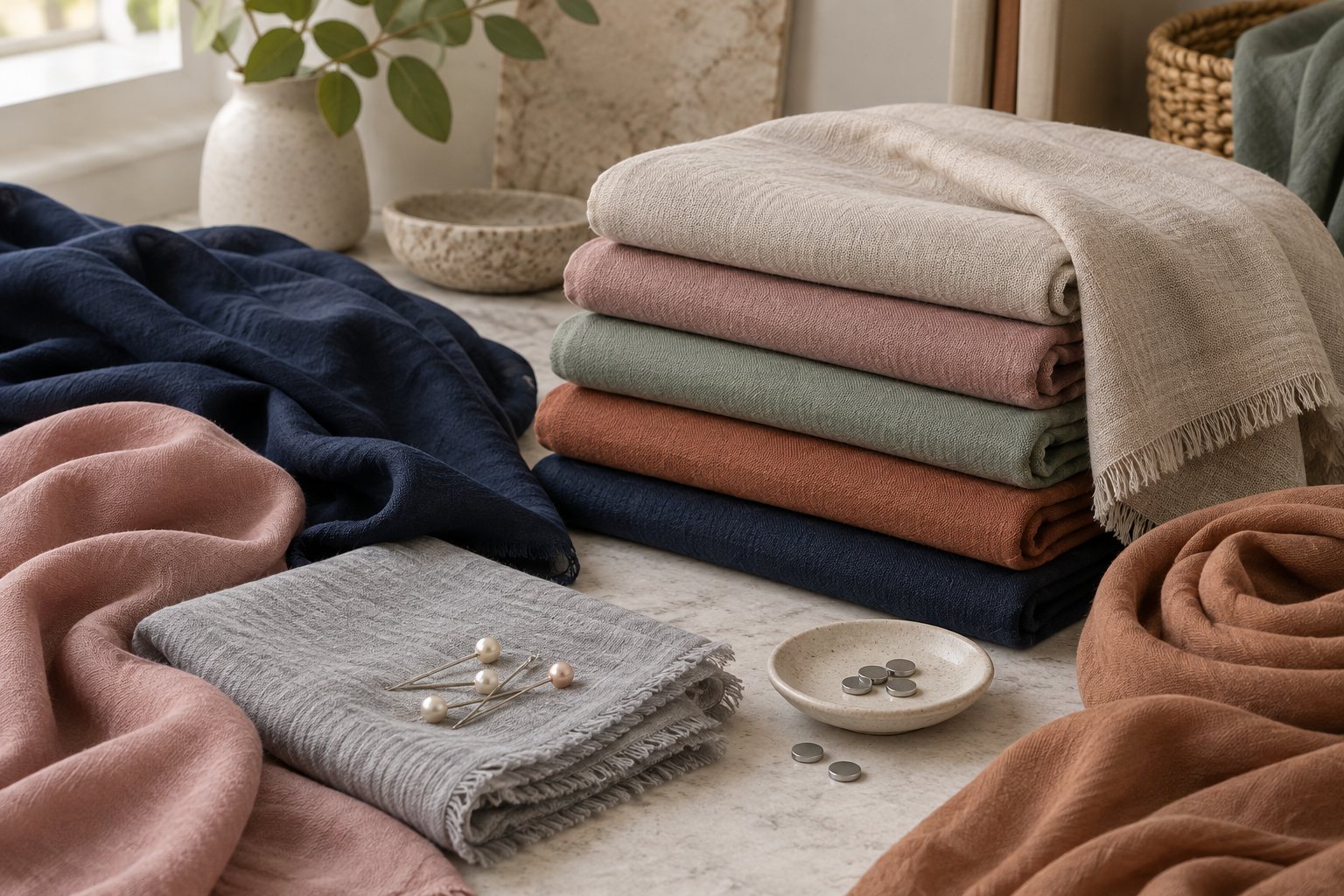
Why accessories matter in a hijab range
A customer buying a chiffon rectangle usually needs something to hold it. If the store offers pins in matching colors or a set of magnets at the checkout, the sale is complete; if not, the customer looks elsewhere. Pins and magnets also make good gift-set fillers and multipacks. The sourcing work is simple compared with garments, but the details that cause complaints, such as rough points, rust, snagging and weak magnets, are easy to specify in advance. The guide on keeping a hijab from slipping explains where pins and magnets fit for wearers.
Hijab pins
| Type | Description | Points to specify |
|---|---|---|
| Straight pins | Fine pins with a small plain or colored head | Length, wire gauge, point finish, head color |
| Pearl or ball-head pins | Straight pins with a faux pearl or colored ball head | Head size and finish, how firmly the head is fixed |
| Safety pins | Closed pins with a clasp, for pinning under the chin or at the shoulder | Size, clasp strength, plating |
| Pins with safety caps | Straight pins with a removable cap over the point | Cap fit and material, how the cap stays on |
| Decorative pins | Pins with a decorative head or brooch-style front | Decoration attachment, finish, weight |
The point decides whether a pin snags fine chiffon. A smooth, sharp point slides between yarns; a rough or blunt one pulls threads. We test sample pins on the fabrics your range sells. Plating and rust resistance are confirmed on the spec sheet, since pins are often stored in damp bathrooms. Pins with safety caps are a sensible default for retail packs, because they reduce pricks during handling and in the customer's bag.
Hijab magnets
Hijab magnets come as pairs: one part goes inside the fabric layer and one outside, holding the folds without piercing the fabric. They appeal to customers who wear delicate chiffon or silk-feel hijabs and do not want pinholes. The two variables that matter are coating and strength.
- Coating: magnets are usually coated or covered, with fabric, enamel, plastic shells or metal caps. The coating protects the magnet, protects the fabric from marks and decides the look. Coating type and durability are written on the spec sheet.
- Strength: too weak and the hijab slips; too strong and the pair is hard to separate and can pinch. The intended strength is agreed on the sample by testing on the fabric weights you sell, and recorded on the spec sheet.
- Size and shape: round, oval and bar shapes are common; size affects both holding power and how visible the magnet is.
Magnet safety: the most important part of this page
The warning text, the packaging and whether any specific magnet rule applies to your product are part of your compliance assessment, which we recommend you settle with a compliance adviser before launch. On our side, we confirm the magnet size, coating and strength on the spec sheet, check that pairs are packed securely so loose magnets do not escape in transit, and print the warning wording you approve on cards and boxes. The note on hijab magnet safety and the compliance overview give more background.
Materials and other compliance points
Pins and magnets are made from metals, plastics and coatings, so material questions apply. California Proposition 65 warnings depend on the materials and trims used and are part of the buyer's compliance assessment. Pins and magnets are not intended for children, and keeping them out of kids' ranges avoids children's product requirements such as lead limits and small-parts rules applying to them. Country of origin is marked on the packaging.
Packing and presentation
Pins usually sell on cards, in clear tubes or in small tins, in counts that are agreed on the spec sheet. Magnets sell in pairs, in sets of several pairs, or in a small box with a mirror or pouch for gift ranges. Matching pin colors to your hijab palette makes a strong display. If pins or magnets go into gift sets with hijabs, plan the packing so pins cannot pierce the fabric in transit. See hijab packaging options and Eid gift sets.
Inspection
- Points: sample pins checked for burrs and tested on chiffon for snagging.
- Heads and caps: pearl heads and safety caps checked for secure fixing.
- Magnet strength: pairs tested on the agreed fabric weight against the approved sample.
- Coating: checked for chips, peeling and marking on light fabric.
- Packing and warnings: counts, cards and warning text checked against the spec sheet.
Building an accessory line
Most stores start with two or three items: a card of pearl-head pins in mixed neutrals, a pack of safety pins, and one magnet set in a coated finish. Colors follow the hijab palette, so a customer buying a dusty pink chiffon can add matching pins at the same time. Once the basics sell, decorative pins and gift tins can be added for Ramadan and Eid. Product pages should state the pin length, the count per pack, the magnet coating and the warning text, so customers know exactly what they are buying and who the product is for.
MOQ and lead time
Pins and magnets are usually ordered alongside a hijab program, and minimums depend on the item, the color and the packing format. Stock items in standard packs typically need less sampling time than garments; custom colors, printed cards and branded tins add steps. Every minimum and date is a reference range, confirmed in writing for each program on the MOQ and lead time page. Send the pin types, magnet sizes, colors and pack formats you want through the sample request form.