
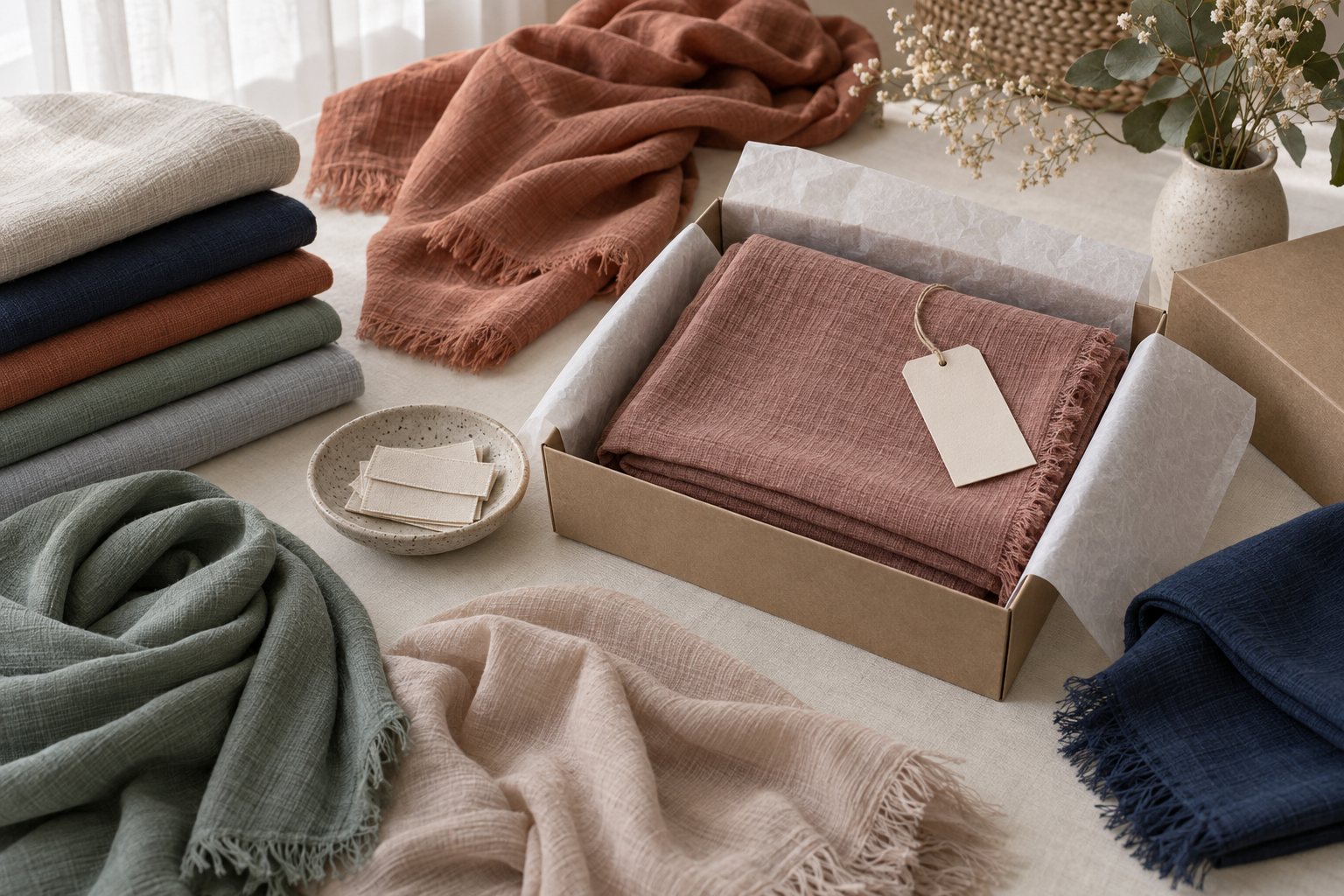
What private label means on a hijab
On a hijab, private label is a small set of physical items: a brand label, a content and care label, a hang tag or sticker, and the bag or box the scarf is sold in. Together they carry your brand and the information your market requires. They are cheap compared with the scarf, but they hold up shipments when they arrive late or carry the wrong wording, so they are planned with the same care as fabric and color.
A hijab has no obvious seam for a label, which makes placement a real decision. A label sewn into the hem of a chiffon rectangle can show through or pull the edge. A label on an instant hijab sits at the back seam. Some buyers prefer a small printed label on light fabrics and a woven label on jersey. We propose a position for each style and confirm it on the approved sample.
Label types
| Item | What it is | Usually suits | Notes |
|---|---|---|---|
| Woven brand label | Brand name or logo woven into a small fabric label | Jersey, instant hijabs, caps, khimars | Soft-edge options reduce scratching; fold type confirmed on sample |
| Printed brand label | Logo printed on satin or soft tape | Chiffon, voile, satin, light modal | Lighter and less visible through sheer fabric |
| Content and care label | Fiber content, country of origin, care instructions, RN or company name | All styles sold where labeling rules apply | Wording approved by you before printing |
| Hang tag | Card tag attached with a fastener or string | Retail and boutique programs | Can carry style name, size, barcode and brand story |
| Sticker or band | Paper band or sticker around the folded scarf | Programs avoiding tag holes in fine fabric | Useful on chiffon and satin |
Content, origin and care: the labels that carry rules
For textile products sold in the United States, the Textile Fiber Products Identification Act and the FTC rules under 16 CFR Part 303 call for fiber content by generic name and percentage, the country of origin, and the identity of the manufacturer or dealer, shown as a company name or an RN. The FTC Care Labeling Rule, 16 CFR Part 423, covers care instructions on textile wearing apparel; how it applies to scarves and headwear is a classification question to confirm with a compliance adviser. Country of origin marking, such as "Made in China", is part of the label. Read US labeling requirements for the detail.
Fiber names deserve care. Viscose made from bamboo must be labeled as viscose or rayon "from bamboo", not as bamboo. A label is a legal statement, so its wording comes from the approved fabric composition, not from a marketing description.
Packaging options
Packaging depends on channel. Online sellers want slim, protective packs that photograph well and survive transit. Boutiques may want a tag and a clear bag so the color shows. Gift buyers want boxes. The common options are:
- Single polybags: clear or frosted, with or without a printed warning or logo, sized to the folded scarf.
- Folded with a paper band: a printed band around the scarf, often inside a polybag.
- Gift boxes: a rigid or folding box for one scarf or a set with pins or an underscarf.
- Pouches: fabric pouches for premium lines or gift sets.
Any warning text required on bags, such as a suffocation notice where your market or channel asks for one, comes from your own requirements and is printed as supplied. Fold size is set first, because it decides bag and box sizes. See packaging options for how each choice affects cost per piece and carton count.
Who supplies what
| Item | Buyer supplies | Workshop supplies, coordinated by the desk |
|---|---|---|
| Brand artwork | Logo files, brand colors, fonts or font files | Label and tag proofs from your artwork |
| Label wording | RN or company name, approval of final wording | Draft content and care text from the approved fabric composition |
| Barcodes | Barcode numbers registered to your business | Printing barcodes on tags or stickers |
| Hang tags and boxes | Design or brief; or ready-made items shipped to the workshop | Production of tags and boxes to your design, or receiving your items |
| Warnings and inserts | Required wording for your market, from your adviser | Printing and inserting as specified |
| Attaching and packing | Approval of placement on the sample | Sewing labels, attaching tags, folding, bagging, boxing, carton marks |
Approval sequence
- Artwork. You send logo files and any packaging design.
- Proofs. We return label, tag and box proofs with sizes and materials.
- Wording check. Content and care text is checked against the approved fabric composition and your market's rules.
- Sample. Labels and tags are attached to the approved sample in the agreed positions.
- Bulk. Label and packaging production runs alongside fabric so nothing waits.
Minimums for labels and packaging
Woven labels, printed tags and boxes have their own minimums, which are often higher than a first scarf order. Many new brands use one woven label across all styles and colors, and a single hang tag design with a variable sticker for color and style, to keep the number of label variants low. Packaging minimums are confirmed in writing for each program alongside the garment minimums on the MOQ and lead time page.
If you are starting a brand, how to start a hijab brand covers the order of decisions. When your artwork is ready, send it with the sample request form and we will return proofs with the first sample plan.