
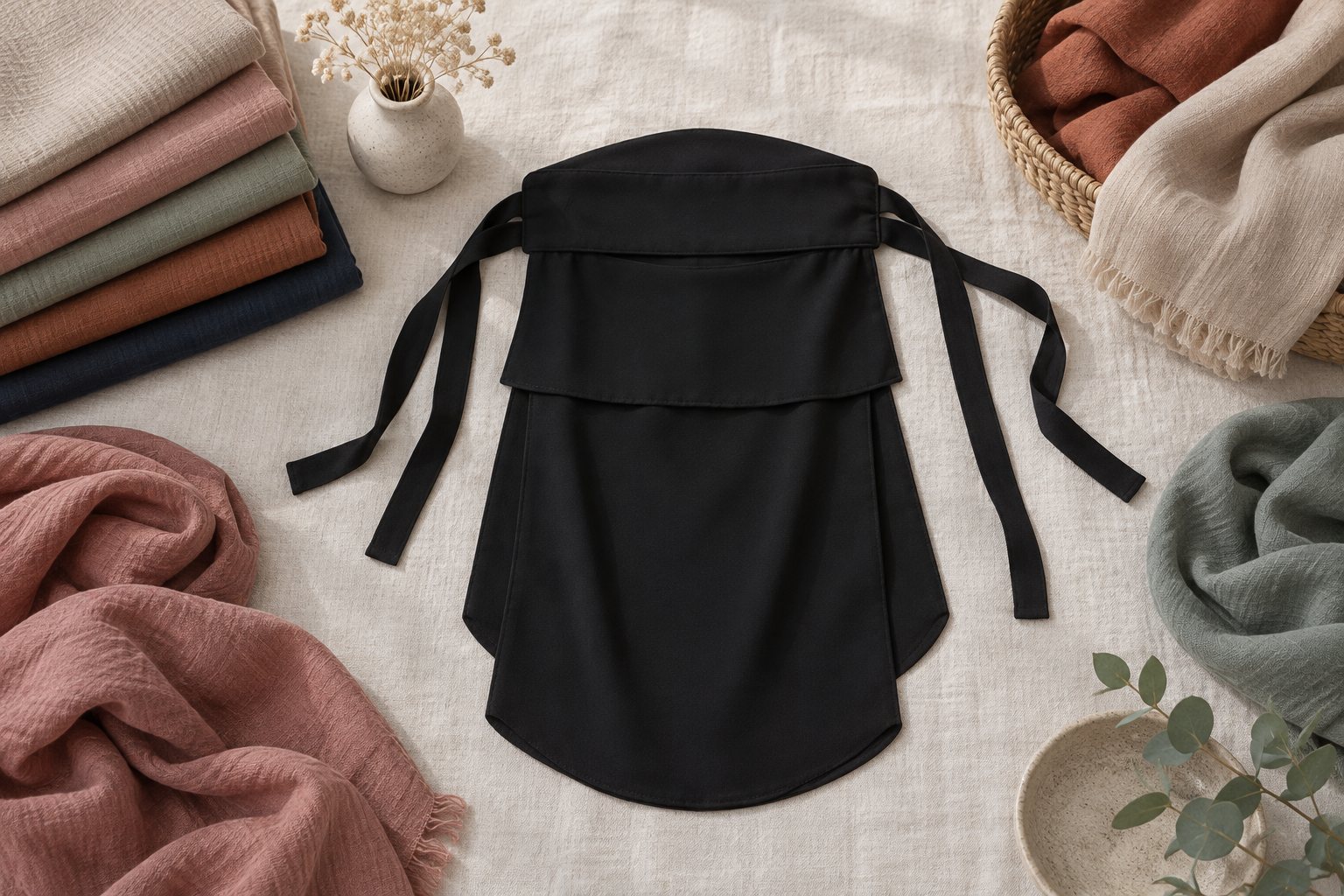
What a niqab is
A niqab is a face veil that leaves the eyes visible. It is worn with a headscarf, often over an underscarf and sometimes with a khimar on top. Wearing practice varies between people, families, communities and regions, and the same word covers several shapes. This page describes the garment and how it is made; it does not give guidance on who wears it or why.
For a wholesale or private label buyer, a niqab is a compact sewn product. It uses little fabric, but customers notice small details: how the edge around the eyes is finished, whether the ties hold without pulling, whether the layers sit flat and whether the fabric breathes. Getting those details into the spec sheet is the difference between a style that reorders and one that comes back as a return.
Styles
| Style | Construction | Usual fabrics | Notes for buyers |
|---|---|---|---|
| Single-layer | One layer of fabric with an eye opening, fastened at the back | Nida, crepe, chiffon | Simple, light, quick to sew; opacity depends on fabric |
| Multi-layer | Two or three layers; an extra layer can flip down over the eye opening | Chiffon for the flip-down layer, nida or crepe for the base | Layer lengths and the sheerness of the top layer are agreed on the spec sheet |
| Tie-back | Long ties at the back of the head, sometimes with a band | Nida, crepe | Tie length and tie width drive comfort and fit |
| Elastic-back | Elastic band at the back instead of, or with, ties | Nida, jersey | Faster to put on; elastic tension and recovery need checking |
Many ranges combine these: a multi-layer niqab with tie-backs is common, and some styles have both elastic and ties. Our post niqab styles compared goes through the variations, and what is a niqab covers the term itself.
Fabrics
Nida, sometimes sold under the trade name medina silk, is the most common niqab fabric in the cluster. It is a matte woven polyester crepe with a soft hand, good drape and little sheen, and it holds its shape without being stiff. Chiffon is used for flip-down layers and lighter styles; it is light and sheer to semi-sheer, which is the point of a flip-down layer but needs care on a base layer. Crepe and some jerseys appear on everyday and elastic-back styles.
We do not publish fabric weights as a fixed figure. The weight is written on the spec sheet for your program, together with the composition and a note on opacity, so the bulk fabric matches the sample. If your customers live in hot climates, say so; a lighter nida or a breathable base layer may suit them better. See nida and medina silk explained.
Construction details that matter
Eye opening
The eye opening is the most visible detail and the one most likely to cause complaints. Its width and depth are measurements, not guesses, and belong on the spec sheet. The edge should be finished cleanly, usually with a narrow hem or binding, so it does not fray or curl. On multi-layer styles, the opening in each layer must line up when the layers are down.
Ties and elastic
Ties need enough length to knot comfortably over a headscarf, and enough width that they do not dig in. They should be stitched securely at the attachment point, which takes the strain. Elastic should recover after stretching; we ask the workshop to check tension on the sample and again in bulk.
Layers
Layer lengths, the order in which layers are stitched and whether the top layer is sheer are all choices. A common construction stitches all layers together at the top band, so the flip-down layer can be lifted over the head. State which layer is which fabric, and how long each is, on the spec sheet.
Band and fit
The band across the forehead or bridge of the nose sets how the niqab sits. Its width and any interfacing affect comfort and how the niqab looks under a headscarf. We sample in the agreed band construction before bulk.
Sourcing notes
Niqabs are sewn by workshops in the cluster that also make khimars, abayas and prayer garments, often in the same nida fabric. That makes it practical to build a coordinated range: a niqab and a khimar in matching color, or a niqab sold with a matching underscarf. If cross-style color matching matters, we plan lab dips on each fabric together.
Most niqabs are sold in black, with navy, dark grey and a few soft neutrals in some ranges. Black is not one color in production: different fabrics and lots show different undertones, so we approve a black reference like any other shade. Minimums for stock colors in standard styles typically start from about 50-100 pieces per color and style, and custom colors typically sit higher, confirmed in writing for each program. Packing usually folds the niqab flat in a polybag, with ties folded inside to avoid tangling.
Inspection on niqabs focuses on the details listed above. Before cartons close, we check the eye opening measurements against the spec sheet, the stitching at each tie attachment, elastic recovery, layer alignment and the shade of the black or colored fabric against the approved reference. Loose threads around the eye opening are the most common defect and the easiest to catch early.
Labels follow the same rules as any textile product sold in the United States: fiber content, country of origin and the manufacturer or dealer identity. Sheer chiffon layers are one reason to plan a flammability check; see compliance. When you are ready, send your style, fabric and colors through the sample request form.