
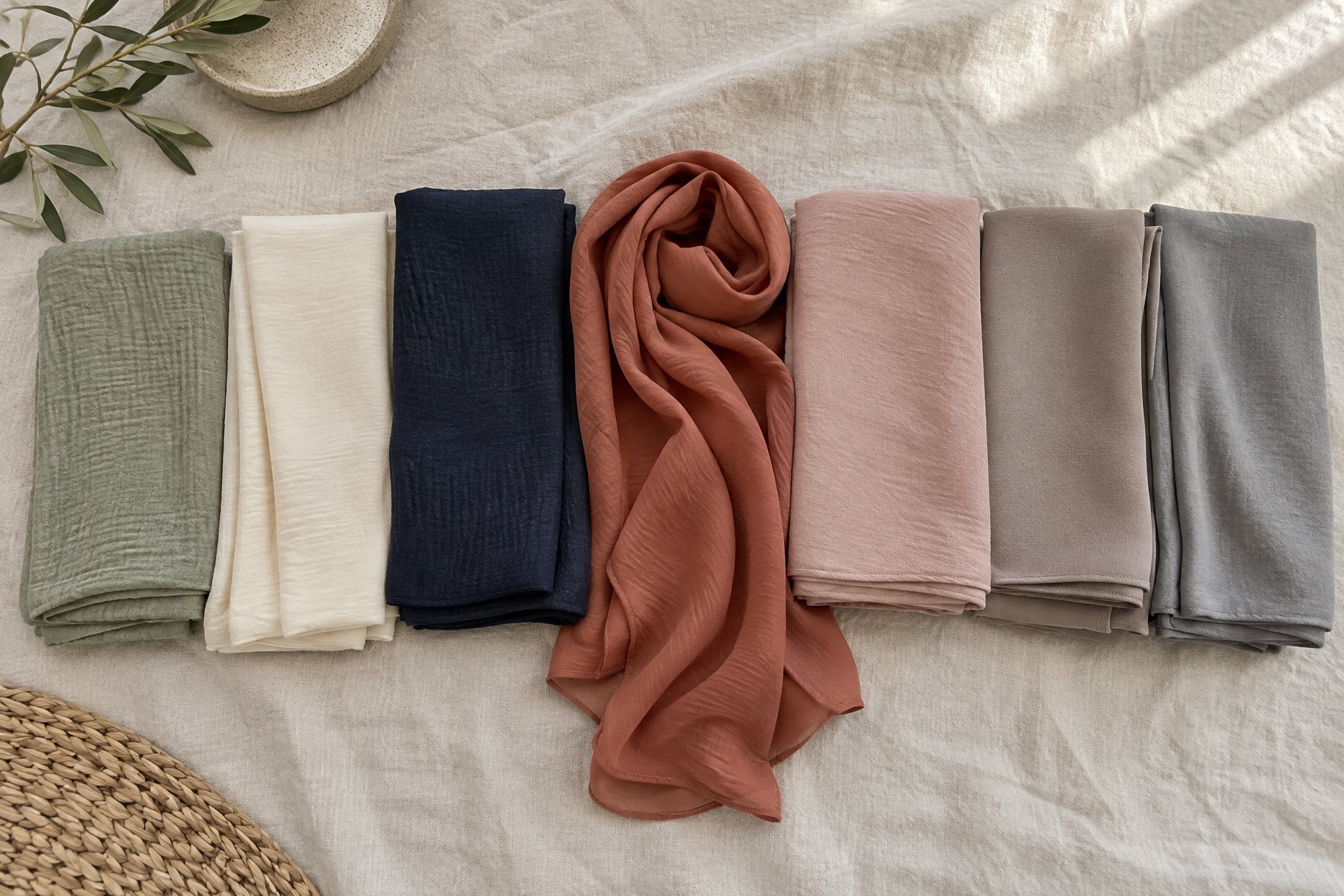
Shapes first, then fabric, then color
Buyers new to the category often start with color, because color is what customers see first. Workshops start with shape and fabric, because those decide cutting, finishing and minimums. A practical range plan follows the workshop: pick the shapes your customers wear, pick the fabrics those shapes work best in, then build a palette across them. The table below is the map we use with buyers.
| Style | What it is | Usual fabrics | Guide |
|---|---|---|---|
| Rectangle (shawl) hijab | Long scarf wrapped and pinned in many styles | Jersey, modal, chiffon, cotton voile, crinkle viscose | Styling |
| Square hijab | Square scarf folded into a triangle | Cotton voile, chiffon, satin, printed modal | Styling |
| Instant hijab | Slip-on, pre-sewn shape, few or no pins | Jersey, modal jersey | Instant hijabs |
| Underscarf or cap | Close-fitting layer under a hijab | Cotton jersey, viscose jersey, cotton-spandex | Underscarves |
| Sports and swim hijab | Pull-on shape in performance or swim knit | Performance jersey, swim knit | Sports and swim |
| Al-amira | Two pieces: a cap and a tube scarf | Jersey, viscose jersey | Al-amira |
| Khimar | Longer cape-like covering to the chest or waist | Nida, crepe, jersey, chiffon | Khimars |
| Niqab | Face veil leaving the eyes visible, worn with a headscarf | Nida, chiffon, crepe | Niqabs |
| Prayer garment | One- or two-piece overgarment for salah | Nida, crepe, cotton blends | Prayer garments |
| Kids' hijab | Smaller instant shapes sized for children | Jersey, cotton-spandex | Kids' hijabs |
Rectangle and square: the wrap-and-pin core
The rectangle hijab is the backbone of most ranges. Wholesale listings commonly show sizes around 70 by 180 centimeters, though length and width vary by fabric and by the styles your customers favor; longer pieces suit wraps that cover the chest, narrower ones suit lighter summer looks. Square hijabs, commonly around 110 to 120 centimeters a side in listings, are folded into a triangle and pinned under the chin or at the shoulder. Squares take prints well, because the full design shows when folded, which makes them a natural home for custom artwork. Size is always written on the spec sheet rather than assumed.
Both shapes depend on edge finish. A rolled or baby hem gives a clean, light edge on chiffon and voile. Overlock is durable and fast, common on jersey. Pressed hems suit crisp cotton. Some knits can be laser cut, which leaves a flat edge without stitching. The finish affects price, drape and how the scarf looks when the edge falls at the face, so it belongs in the brief, not left to the workshop.
Instant styles and underscarves: the fast-moving basics
Instant hijabs and underscarves sell on convenience. An instant hijab is sewn into shape so it slips on with few or no pins; an underscarf holds hair and keeps the outer hijab from sliding. Both are usually jersey, both are sized, and both move fast in neutral colors. They are also where fit complaints come from, so the spec sheet should state the cap circumference, elastic or tie construction, and the stretch the fabric is expected to have. See instant hijabs and underscarves and caps.
Specialist styles: sports, khimars, niqabs and prayer garments
Sports hijabs are pull-on shapes in performance knit, with neck coverage and a back length that stays tucked during movement. Teams and clubs often buy them as part of a uniform. Khimars are longer, cape-like coverings, often in matte crepe such as nida. Niqabs are face veils worn with a headscarf, in single-layer, multi-layer and tie-back styles. Prayer garments are overgarments for salah, sold in one- or two-piece sets. Practice around all of these varies between people, communities and regions; our guides describe the garments, not obligations. For plain explanations of the terms, see hijab, niqab and burqa differences.
Kids' hijabs: a separate rulebook
Children's hijabs look like small instant hijabs, but in the United States a product designed for children 12 and under is a children's product, with its own testing and certificate requirements. Trims, snaps and printed decorations all matter. If a range includes kids' sizes, we plan the test route at the spec stage. Read kids' hijabs.
Accessories that complete a range
Pins and magnets are small items with a large effect on how a range is received. A hijab that needs pins sells better with pins that match; magnets appeal to customers who prefer not to pierce delicate fabric. Magnets carry a safety question, though: small, strong magnets are a known ingestion hazard for children, so they are not marketed to children and should carry a warning. We cover the choices and the paperwork on pins and magnets.
Colors across styles
Customers often build outfits across styles: an underscarf in the same shade as a chiffon rectangle, or an instant hijab that matches a khimar. Matching colors across different fabrics is harder than it sounds, because a knit and a woven take dye differently and look different under the same light. If cross-style matching matters to your range, say so in the brief, and we will plan lab dips on both fabrics together rather than one after the other.
Building a first range
A first range rarely needs every style. A common starting point is two shapes in two fabrics: a jersey rectangle and a modal or chiffon rectangle, or a jersey instant hijab with a matching underscarf. Add a core palette of neutrals and a few seasonal colors, then reorder what sells. Minimums are counted per color and per design, so eight colors in one fabric cost more in minimums than four colors in two fabrics. The MOQ and lead time page explains how this adds up; the sample request form turns your plan into a written quote.