
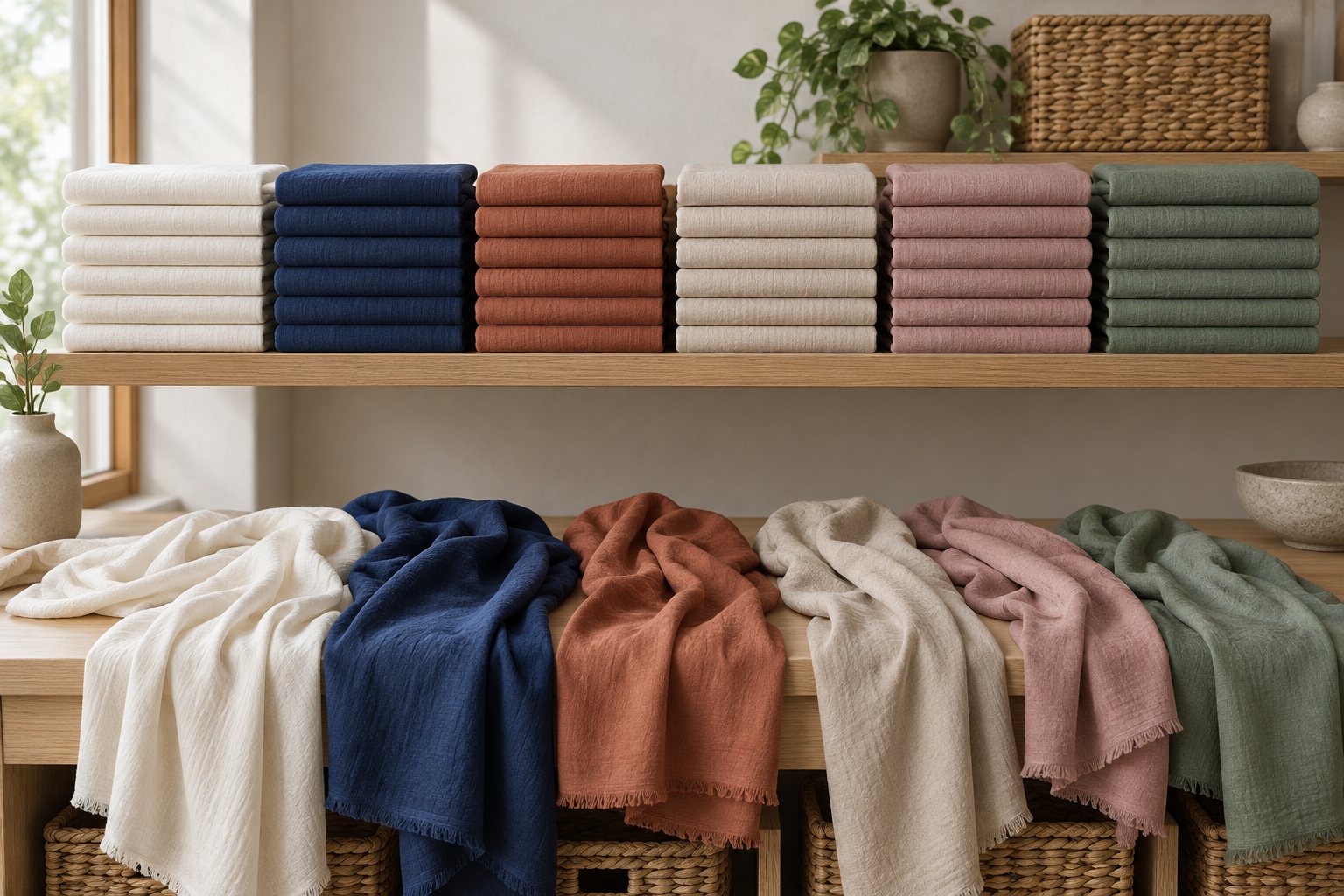
Why a single MOQ number does not exist
Buyers often ask for "the MOQ" as if it were one figure. In a hijab program it is several. A workshop counts minimums per color, per design and per fabric, because each of those is a separate run on a machine: a dye lot, a print setup, a cutting lay. A range of six colors in one fabric has six minimums. Add a printed square in three designs and you add three more, each with its own rules. The useful question is not "what is the MOQ" but "what is the minimum for each line in my range, and what changes it".
The figures below are typical reference ranges drawn from published supplier practice in the Yiwu cluster. They help you plan before you ask. They are not offers, and every one of them is confirmed in writing for each program once the fabric, size, finish and packaging are fixed.
Reference ranges
| Item | Typical reference range | What moves it |
|---|---|---|
| Stock colors, standard hijab styles | Typically from about 50-100 pcs per color/style; some workshops list lower for stock | Whether the fabric and color are already on the shelf |
| Custom color, dyed to a reference | Typically higher than stock, often set by the dye lot; confirmed per fabric | Fabric type, dye method, shade depth |
| Custom print, digital or screen | Typically from about 100 pcs per design; confirmed per fabric and print method | Print method, number of colors in the artwork, fabric |
| Samples | Stock samples ship in days; custom samples about 7 working days in published examples, up to around two weeks for new prints or colors | Lab dips, strike-offs, sewn shape |
| Bulk production | Typically about 25-35 days after sample approval | Quantity, fabric availability, peak season before Ramadan and Eid |
We do not publish prices. A price depends on fabric, size, edge finish, print, labels and packaging, and is quoted per program from the spec sheet.
How fabric changes the minimum
Fabric is the first lever. Jersey in common neutrals is often held as stock, so a workshop can cut and sew a small run without ordering new fabric. Chiffon, modal and cotton voile are also widely held, but the exact construction you want may not be. If the workshop has to order greige fabric from a mill, the mill's own minimum applies, and that is usually what sets the program minimum. See the fabric guide for which fabrics behave which way.
How color and dye lots change the minimum
A stock color is a shade the workshop or mill already has in fabric. A custom color is dyed to your reference, and dyeing happens in lots. A dye lot has a practical minimum length of fabric, and one lot becomes a certain number of hijabs depending on size and fabric. That is why custom colors typically sit above stock minimums and why the figure is confirmed per fabric.
Dye lots also matter on reorder. Two lots of the same color can differ slightly in shade. For core colors that sell all year, we keep the approved lab dip and the bulk shade reference on file, so the next lot is checked against the same standard. Read more in hijab MOQ explained.
How print changes the minimum
Digital printing suits small runs and artwork with many colors, because there are no screens to make. Screen printing suits larger runs of simpler artwork, where the setup is spread across more pieces. Both typically start from about 100 pieces per design, confirmed per fabric and print method. Each new design is a new strike-off and a new approval, so a range of many designs adds sampling time as well as minimums. Our custom printed hijabs page compares the routes.
A typical timeline
- Brief and spec sheet. Style, fabric, size, colors or artwork, quantity per line, labels and packaging written down and approved.
- Samples. Stock samples in days. Custom samples, lab dips and strike-offs about 7 working days in published examples, up to around two weeks for new prints or colors.
- Approval and confirmation. You approve the sample; MOQ, lead time, test plan and packing are confirmed in writing.
- Bulk. Typically about 25-35 days after sample approval, longer in peak season.
- Inspection and packing. Checked against the approved sample and spec sheet before cartons close.
- Shipping. Air or sea, booked to your date. Transit is extra and depends on mode and destination.
Ramadan and Eid: plan backwards
Demand for hijabs, prayer garments and gift sets peaks ahead of Ramadan and Eid, and workshops in the cluster are busiest in the weeks before. Lead times stretch, and late changes become harder to absorb. The dates move each year with the Islamic calendar, so the planning date moves too.
The practical rule is to plan backwards from the date the goods must be on your shelf or in your warehouse. Subtract transit, then inspection and packing, then bulk, then sampling and approval, then a margin for one round of corrections. For seasonal ranges that usually means a brief several months ahead, not weeks. Our post on planning for Ramadan and Eid includes a worked schedule.
Keeping minimums manageable
Most buyers meet minimums comfortably once the range is shaped around them. A few habits help. Choose fewer colors in more fabrics rather than many colors in one. Start prints on one fabric and one size. Use stock colors for basics such as underscarves and keep custom shades for the hero pieces. And tell us your reorder plan, because a program with predictable reorders can often be sampled and scheduled differently from a one-off order.
When you have a draft range, send it with quantities per line through the sample request form. The reply will show the minimum per line, the expected timeline and what would change either.