
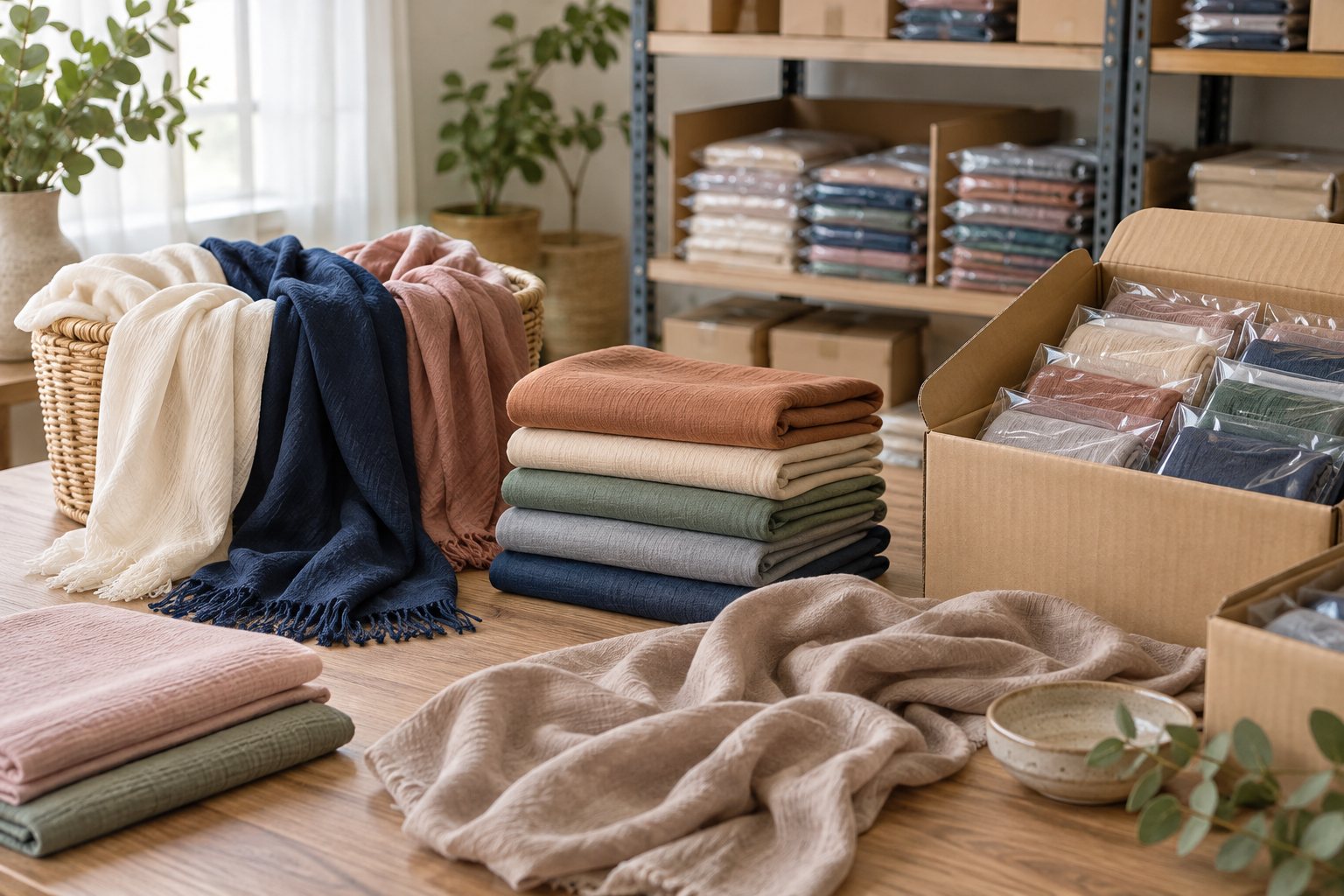
What retail buyers actually need
A boutique, an online store and a mosque shop sell to different customers, but their wholesale problems are similar. The bestselling colors run out at the wrong moment. A reorder arrives in a slightly different shade from the last one. Cartons arrive mixed, so receiving takes a day. And a seasonal rush, usually ahead of Ramadan and Eid, lands at the same time as everyone else's. Wholesale hijabs are less about finding a scarf and more about setting up supply that behaves the same way every time.
We coordinate wholesale programs through partner workshops in the Yiwu scarf cluster that already run the core fabrics. Our job is to fix the spec once, keep the shade references on file and make every reorder a repeat of the last one, not a new negotiation.
Three kinds of retail buyer
Boutiques
Boutiques sell on curation. They usually carry fewer pieces per color and more fabrics: a jersey rectangle for everyday wear, a chiffon or satin piece for events, perhaps a printed square. They benefit from stock colors, which keep minimums low, and from small custom runs on one hero fabric.
Online stores
Online stores sell on consistency. The product photo has to match the product in the parcel, color for color, so shade control matters more than for a shop where customers see the scarf before they buy. Online stores also care about packing: one hijab per polybag, a barcode or SKU label and folded dimensions that suit their shipping boxes. See selling hijabs online.
Mosque shops and community stores
Mosque shops and community stores sell on availability. Customers expect everyday hijabs, underscarves, prayer garments and kids' sizes in familiar colors, all year, with a visible lift before Ramadan and Eid. These programs work best with a short core list and a steady reorder rhythm. Our post on buying for mosque shops and community stores covers range size and stock levels.
The core palette
Most retail ranges are built around a core palette: neutrals and a few deep colors that sell all year, in two or three styles. Black, navy, grey, beige, dusty pink and olive appear in many ranges, but your sales data is the better guide. The core palette is where restocks come from, so it is where shade control pays off.
| Line | Typical styles | Color approach | Reorder pattern |
|---|---|---|---|
| Core | Jersey rectangle, instant hijab, underscarf | Stock or approved custom shades, kept on file | Regular restocks across the year |
| Dressy | Chiffon rectangle, satin or silk-feel square | Neutrals plus a few seasonal colors | Lift before Eid, weddings and events |
| Seasonal | Printed squares, cotton voile rectangles | New prints or colors each season | One run per season, rarely repeated |
| Add-ons | Pins, magnets, prayer garments, kids' hijabs | Matched to core colors | With core restocks |
How minimums work for wholesale
For stock colors in standard styles, workshops typically start from about 50-100 pieces per color and style. Custom colors are typically higher, often set by the dye lot, and custom prints typically start from about 100 pieces per design. All of these are typical reference ranges, confirmed in writing for each program. The practical effect is that a range of eight colors in one fabric carries eight minimums, while four colors in two fabrics may carry the same number with a better spread of choice. We help shape the first order so each line meets its minimum without overstocking slow colors.
Case packing
Packing is where wholesale programs save or lose time on arrival. We agree packing on the spec sheet, typically in three layers:
- Unit. Each hijab folded to a set size, in a polybag with a label showing SKU, color and size if needed. Hang tags or care cards go here if you use them.
- Inner pack. A fixed number of units of one color and style, so a shop can put a full pack on a shelf and an online store can count stock quickly.
- Carton. One style per carton where possible, with a carton label listing style, colors and quantities, so cartons can be received without opening.
Fiber content, country of origin and care information are part of the label plan from the start; see compliance for what US labels need. Packaging options, including gift boxes for Eid, are covered in hijab packaging options.
Setting a reorder rhythm
A reorder rhythm turns wholesale buying from reaction into routine. Most retail buyers settle on a regular restock of core colors, plus one or two larger seasonal orders. The rhythm depends on lead time: bulk typically takes about 25-35 days after sample approval, longer before Ramadan and Eid, and shipping is extra. On a reorder there is usually no new sample, only a shade check against the reference on file, so the cycle is shorter than for a first order.
Two habits make reorders smoother. First, place the reorder when stock reaches a set level, not when it runs out; your lead time plus a margin tells you what that level is. Second, keep the spec sheet unchanged unless you mean to change it. A small change to fabric, size or label turns a reorder into a new program with new samples.
Starting a wholesale program
Send your channel, your customer, the styles and colors you already sell well, and rough quantities per color. If you have a sample you want to match, include it. The reply will propose a first order shaped around minimums, a sampling plan and a packing plan. Use the sample request form to begin.