
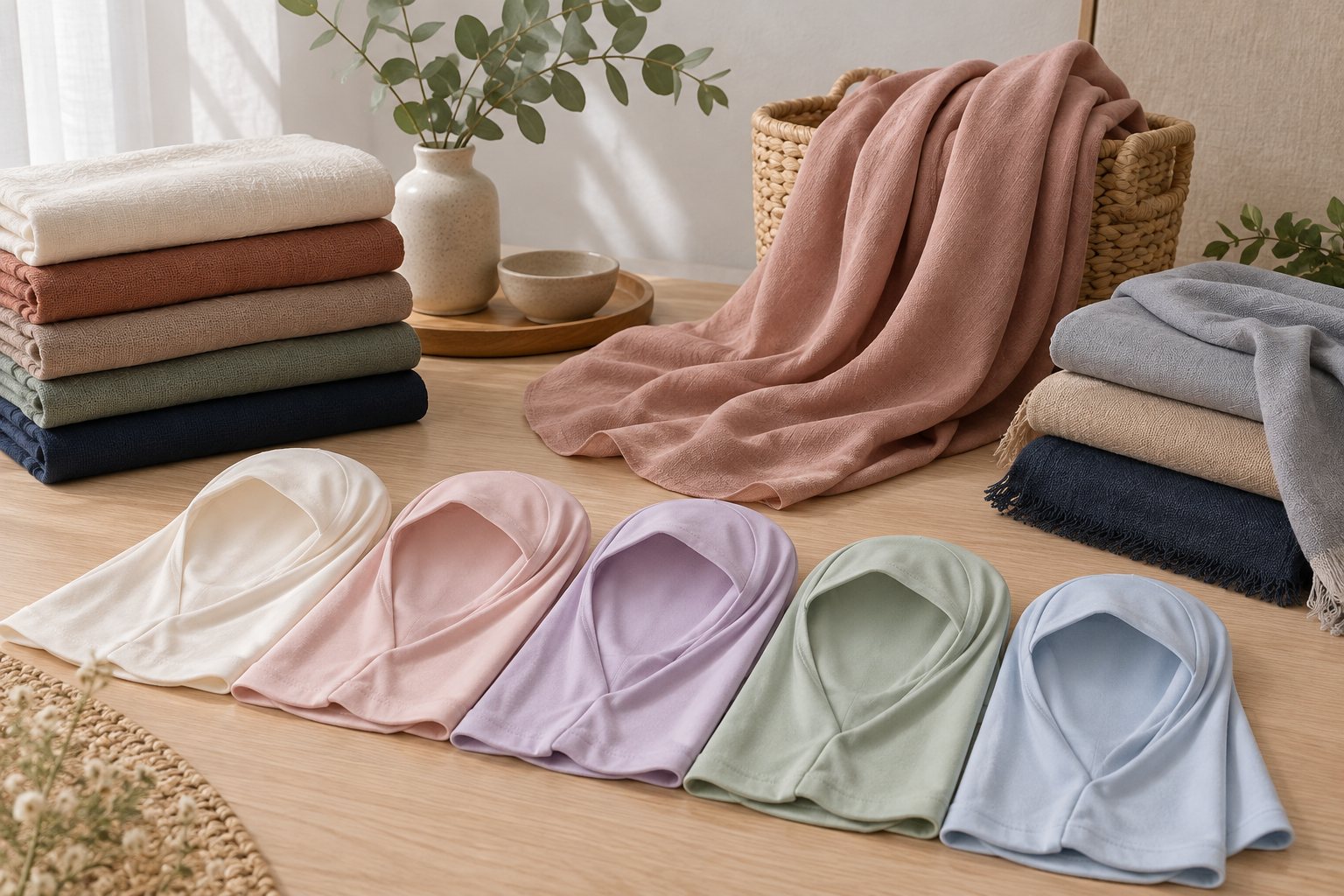
A separate line with its own rulebook
Parents and schools buy kids' hijabs for the same reasons adults choose instant styles: they go on quickly, they stay in place, and there is nothing to pin. For a store or a school uniform supplier, they are a natural extension of an adult range. The difference is regulatory. In the United States, a product designed or intended primarily for children 12 and under is a children's product under the Consumer Product Safety Improvement Act (CPSIA). That brings testing, certification and labeling duties that do not apply to the adult version of the same style. We plan kids' lines as a separate program from the first brief.
Styles that suit kids' ranges
Most kids' ranges use slip-on shapes, because there are no pins and little to adjust.
- Slip-on instant: a one-piece knit hood with a fitted front band. See instant hijabs for the adult versions.
- Al-amira two-piece: a cap plus a tube scarf; popular for school wear. See al-amira hijabs.
- Caps: tube or bonnet caps in soft jersey, used alone or under a slip-on.
- School uniform styles: plain slip-ons dyed to the school's color reference, sometimes with a printed crest.
Pinned rectangle and square scarves are generally left out of kids' ranges, and pins and magnets are not marketed for children at all.
Sizes by age range
Kids' hijabs are sized by age range rather than by a single measurement. The age bands, and the garment measurements for each band such as opening, front band and back length, are written on the spec sheet with tolerances and checked on the sample. Age ranges are a guide for parents; the measurements are what the workshop sews to. A size chart printed on the hang tag or product page helps parents choose and reduces returns. The hijab sizing guide covers how to present sizes.
CPSIA basics for kids' hijabs
The table below summarizes what usually applies. It is general information, not legal advice; confirm the exact requirements for each item with your compliance adviser.
| Requirement | What it covers | How we plan it |
|---|---|---|
| Third-party testing | Testing at a CPSC-accepted laboratory where a children's product safety rule applies | Test plan agreed at the spec stage; samples sent to the lab you choose |
| Children's Product Certificate | A certificate issued by the importer or domestic manufacturer, based on the test results | We collect test reports and production details for your certificate |
| Tracking labels | Permanent marks on the product and its packaging that identify the source and production batch | Label content agreed with you and your adviser, printed per batch |
| Lead limits | Lead in paint, coatings and substrates of trims and accessories | Trims chosen with lead limits in mind; tested where required |
| Small parts | Parts that could detach on items for young children | Avoid detachable trims on young sizes; pull-test any attachment |
| Flammability | Clothing textiles under 16 CFR Part 1610 | Test plan confirmed per fabric with your adviser |
Ties, trims and decoration
Ties need extra care on children's items. US guidance on drawstrings in children's upper outerwear (16 CFR 1120) is about cords at the hood and neck, and while a kids' hijab is not a jacket, the same thinking is useful when a style has ties at the back or neck. Most kids' ranges avoid long ties and use enclosed elastic or a short, securely anchored tie instead. Whether a particular design raises a concern is confirmed per item with your adviser.
Decorations follow the same logic. Printed designs are generally simpler than attached ones. Beads, rhinestones, sequins, buttons and small bows add lead and small-parts questions and are best avoided on young sizes. If an attached trim is part of the design, we specify the attachment method and pull-test it on the sample.
Fabrics and comfort
Soft jersey is the usual choice: cotton jersey for breathability, viscose jersey for a cooler, smoother feel, and cotton-spandex for caps that hold their shape. Seams at the front band are kept flat. Labels are placed where they will not irritate, or printed directly onto the fabric where the label rules allow. Colorfastness and shrinkage after washing matter more for kids' items, which are washed often; we include a wash check in the sample review. Care instructions on kids' items are kept simple, since they are often washed with the rest of the family laundry, and the care label is agreed on the spec sheet with the other label content.
School uniform programs
Schools and uniform suppliers need a hijab in the school color, sized across age groups, with a reorder plan for each new school year. Colors are matched to the school reference with a lab dip; a printed crest is placed away from seams and stretch zones. The guide to hijab uniform programs covers size runs and reorders, and the compliance overview explains how children's product rules fit with the rest of the label requirements.
MOQ, testing time and lead time
For stock colors in standard kids' styles, workshops typically start from about 50 to 100 pieces per color and style; each size may count separately, which is confirmed in writing. Laboratory testing adds time that adult programs do not need, so plan it into the schedule from the start. Samples take about seven working days to two weeks for new colors, and bulk typically runs about 25 to 35 days after approval, plus testing time. These are reference ranges, confirmed in writing for each program on the MOQ and lead time page. Send your age ranges, styles and colors through the sample request form.