
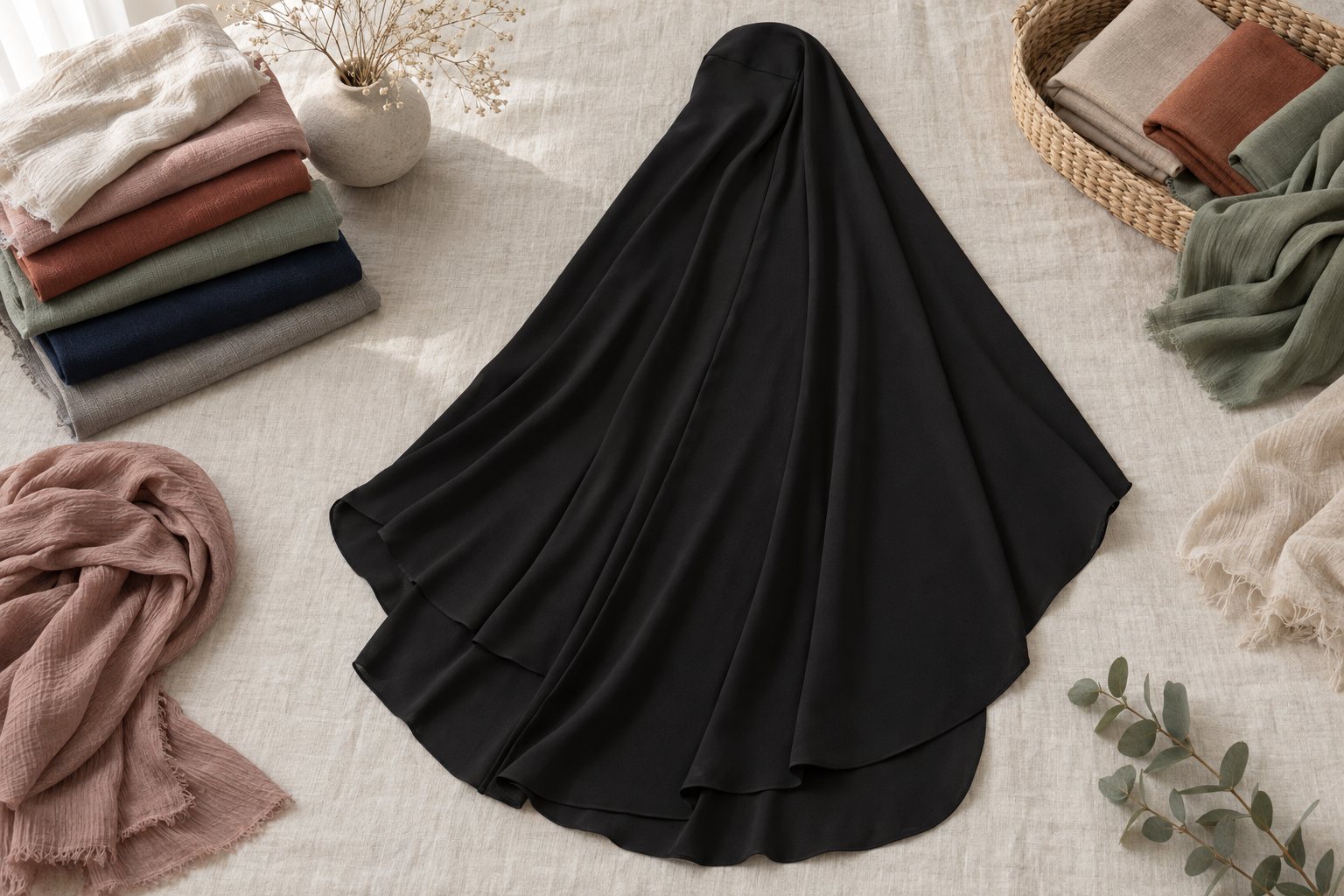
What a khimar is, and who buys it
Khimar is an Arabic word for a head covering; in the modest-wear trade it usually means a single-piece garment that covers the head and falls in a cape over the shoulders, chest and often the back, sometimes to the waist, hip or knee. It is worn over the hair with the face visible, and many wearers like it because there is nothing to wrap or pin. Some wear one every day, some for prayer or visits to the mosque, and some keep one for travel. How and why people wear it varies between individuals, families, communities and regions, and a product page only needs to describe the garment and its fabric.
Buyers include modest-fashion brands building an outerwear-style line, community stores and mosque shops, and online stores that sell khimars alongside abayas and prayer sets.
Lengths and how to describe them
Length is the first decision, and it changes fabric use, weight and price. Workshops do not share one standard, so we write the length in centimeters on the spec sheet and describe it to customers in plain words.
| Length name | Where it falls | Notes |
|---|---|---|
| Shoulder | Just over the shoulders | Light and quick; often in jersey |
| Chest | Covers the chest | The common everyday length |
| Waist | To around the waist | Popular in nida and crepe |
| Hip | To around the hip | Often has arm openings or a split at the sides |
| Knee or longer | Close to the knee or below | Usually crepe or nida; weight matters |
Because body measurements vary, length names are approximate. Writing the centimeter figure on the label or product page reduces returns.
Constructions
- Single layer: one layer of fabric with a shaped front opening, often with an elastic or fitted band at the forehead.
- Double layer: two layers sewn together for more opacity and body, common in lighter fabrics.
- Built-in cap: an inner jersey cap sewn into the khimar so it stays in place without a separate underscarf.
- Tie-back: ties at the back of the head for adjustment.
- Side splits or arm openings: on longer lengths, to make movement easier.
Each of these changes the pattern and the sewing time. Choose one or two for a first order and write them clearly on the spec sheet.
Fabrics: nida, crepe, jersey and chiffon
Nida and medina silk are trade names for a matte woven polyester crepe that drapes well, resists wrinkles and is widely used for khimars, niqabs and abayas. Despite the name, medina silk is not silk, and the US fiber label must state the actual fiber, usually polyester, by its generic name. The guide to nida and medina silk covers the differences between qualities.
Other crepes give a slightly different hand and sheen. Jersey makes a softer, stretchier khimar that suits shorter lengths and warm weather. Chiffon khimars are usually double-layer or lined, because single-layer chiffon is sheer. Whatever the fabric, weight is confirmed on the spec sheet and opacity is checked on the finished sample in daylight.
Edges, bands and finishing
The hem on a long khimar is visible and takes wear. Rolled hems suit light fabrics; overlocked and turned hems suit crepe and jersey. The front band around the face opening is where comfort is decided: a soft band with enclosed elastic is common, and its width and tension are agreed on the sample. Pressing and folding matter too, since a crepe khimar folded badly arrives creased. We agree the fold and the bag size on the spec sheet.
Colors and matching
Khimars sell mostly in black, navy, grey, brown and soft neutrals, with seasonal shades added. Customers who buy a khimar and a matching prayer set or abaya expect the shades to match, so if your range includes coordinated pieces, plan lab dips together. See prayer garments for the related line.
Where khimars go wrong
- Length drift. Long garments cut from roll ends can come out short. Inspectors measure front and back length on every size against the spec sheet tolerance.
- Uneven hem. A crooked hem shows clearly on a long cape. Hems are checked flat and on a form.
- See-through fabric. A lighter roll than the approved sample can slip into bulk. Opacity is checked against the approved sample in daylight.
- Creasing. Poor folding leaves hard creases in crepe. Folding method and bag size are checked at packing.
Building a first khimar line
A first order rarely needs every length. Many buyers start with one construction in two lengths, such as chest and waist, in nida or crepe, across four to six core colors. A jersey shoulder-length khimar can be added for warm months. Once reorders show which length and colors move, the line can grow into longer lengths, printed fabrics or coordinated prayer sets in the same shades.
Labels and compliance
For the United States, a khimar generally needs fiber content by generic name and percentage, country of origin and dealer identity under the Textile Act rules, plus care instructions. Trade names such as nida or medina silk can appear in marketing, but the label states the generic fiber. Sheer or very light woven fabrics should be considered for flammability testing under 16 CFR Part 1610; discuss it with your compliance adviser. The guide to hijab labeling requirements explains the label content.
MOQ and lead time
Khimars in stock colors typically start from about 50 to 100 pieces per color and length at workshops in the cluster; custom colors are dyed by lot and usually need more. Longer lengths use more fabric, so minimums and timing can differ by length. Samples take about seven working days to two weeks for new colors, and bulk typically runs about 25 to 35 days after approval, longer before Ramadan and Eid. All of these are reference ranges, confirmed in writing for each program on the MOQ and lead time page. Send lengths, fabric and colors through the sample request form.