
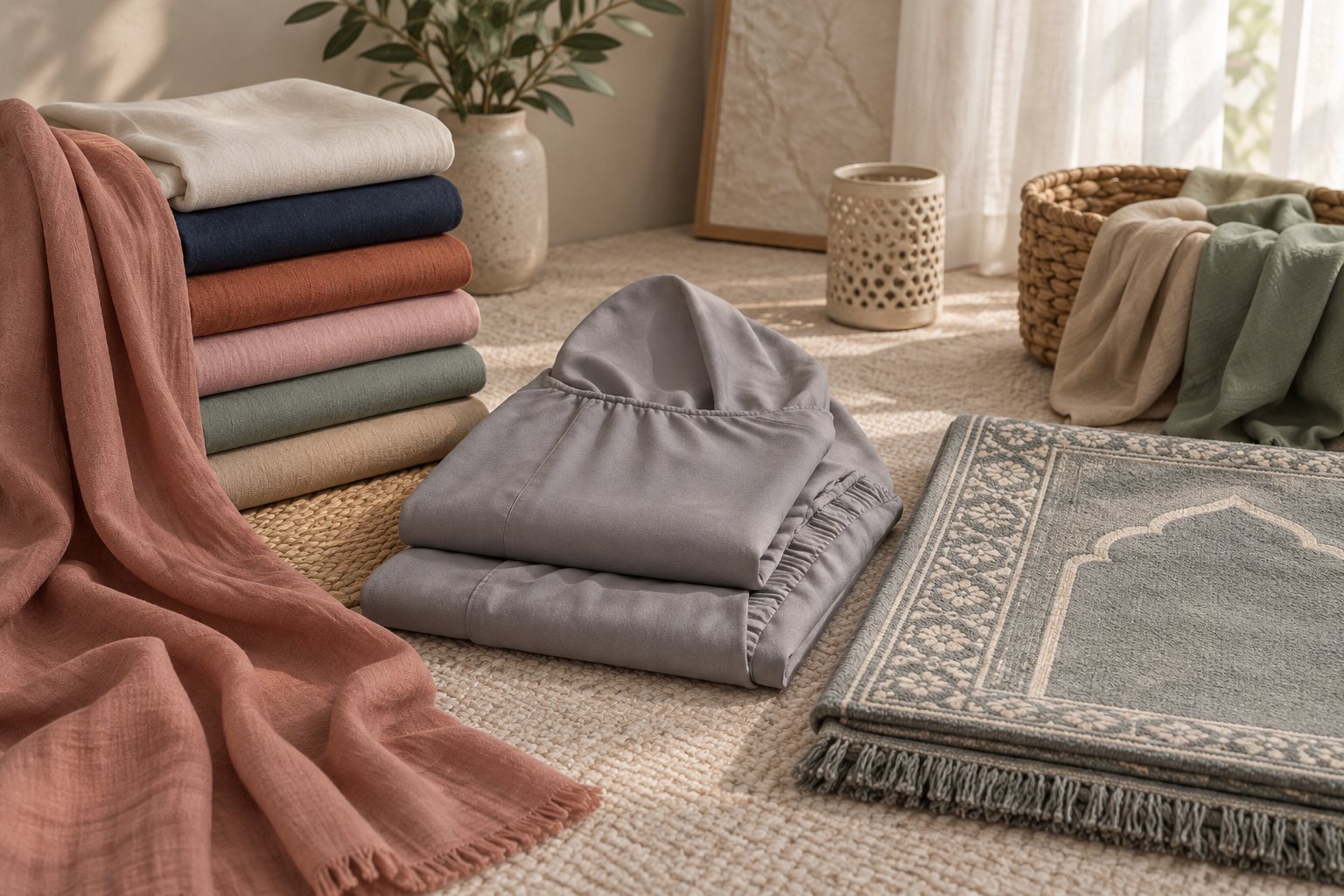
What a prayer garment is for
Many women keep a loose overgarment that they put on over everyday clothes for salah, so they do not need to change outfits five times a day. Some keep one at home, one at work and one in a bag. Mosques often keep a few for visitors, and travellers pack a light set in a pouch. Practice varies between people, families, communities and regions, and the desk does not advise on what anyone should wear. What we can do is make the garment easy to put on, comfortable to move in, opaque and neatly finished.
For a store, prayer garments are a steady line through the year with a clear peak before Ramadan and Eid, when they are bought as gifts. The guide to buying for mosque shops and community stores covers how they fit into a community store range.
One-piece and two-piece sets
| Type | Construction | Points to specify |
|---|---|---|
| One-piece | A single garment with a head section and a long body, sometimes with sleeves or a cape cut | Total length, face opening and band, sleeve or cape style |
| Two-piece | A top piece covering head and upper body, plus a separate long skirt | Top length, skirt length, waistband type |
| Travel set | A lighter one- or two-piece set packed in a matching pouch | Fabric weight, pouch size and closure |
| Kids' set | A smaller one- or two-piece set sized by age range | Sizes by age range, trims, children's product rules |
Two-piece sets are common because the skirt can be sized more loosely and the top is easy to slip on. One-piece sets are quick to wear and pack. Many ranges carry both.
Fabrics
Nida and other matte crepes are widely used: they drape, resist creasing and are opaque at modest weights. Cotton blends feel cooler and suit warm climates, though they crease more. Jersey makes a soft, stretchy set that is comfortable for longer wear. Whatever the choice, opacity is the first test, checked on the finished sample in daylight. Weight is confirmed on the spec sheet, because a set that is too heavy is tiring to wear and bulky to carry, while one that is too light can be see-through. Prints are possible, usually small florals or tone-on-tone patterns; the nida and medina silk note explains the main fabric family.
Details that decide comfort
- Face opening: a soft band with enclosed elastic holds the head section in place; tension and width are agreed on the sample.
- Waistband: two-piece skirts usually have an elastic waist; a drawcord adds adjustment for adult sizes but is avoided on kids' sets.
- Sleeves or cape: some top pieces have sleeves or elastic cuffs; others are cape-cut. Name the one you want.
- Length: state top and skirt lengths in centimeters. Length names such as long or extra long mean different things in different workshops.
- Hem: a turned hem on crepe and a rolled hem on lighter fabrics; the hem is checked for straightness on inspection.
Sizes
Most adult prayer sets are sold in one size, sometimes with a longer or wider version. We write lengths and widths with tolerances on the spec sheet. Kids' sets are sized by age range, with the size chart confirmed on the spec sheet; they are children's products in the United States and are planned separately, as explained on kids' hijabs.
Pouches, gift packing and sets
A matching pouch makes a prayer set easy to carry and makes a natural gift. Pouches are usually cut from the same fabric with a drawstring or zip closure. Gift programs may combine a prayer set with other items in a box; each item is confirmed per program, with its own labels. The guide to Eid gift sets covers bundles for retail and corporate buyers, and folding, inserts and carton counts are written on the spec sheet.
Respectful product wording
Product pages for prayer garments work best when they describe the garment plainly: what it is, the fabric, the lengths, how it is worn and how to care for it. Avoid claims about what a customer should wear or rankings of coverage. Photographs can show the garment on a form or folded flat; images do not need to show faces. These are the same rules we apply on this site.
Inspection points
Inspection on a prayer garment program focuses on what customers notice first. Inspectors measure the top and skirt lengths against the spec sheet, check the face opening band and the waistband for even tension, compare the opacity of bulk fabric with the approved sample in daylight, and look for uneven hems, loose threads and open seams. For two-piece sets, they confirm that each bag holds a top and skirt of the same shade and size. Pouches are checked for working closures. Results are shared in writing before the cartons are sealed, with any reworked pieces noted.
Labels and compliance
For the United States, prayer garments generally need fiber content by generic name and percentage, country of origin and dealer identity, plus care instructions. If the set includes two pieces in different fabrics, or a pouch in another fabric, each needs the correct fiber content. Light woven fabrics should be considered for flammability testing under 16 CFR Part 1610; confirm with your compliance adviser.
Planning for Ramadan and Eid
Demand peaks ahead of Ramadan and Eid, and the dates move each year with the Islamic calendar. Workshops are busiest in the same weeks, so bulk typically runs about 25 to 35 days after sample approval in normal periods and longer in peak season. Samples for new colors take about seven working days to two weeks. Stock colors typically start from about 50 to 100 sets per color. These are reference ranges, confirmed in writing for each program; read planning for Ramadan and Eid and MOQ and lead time, then send your set types and colors through the sample request form.