
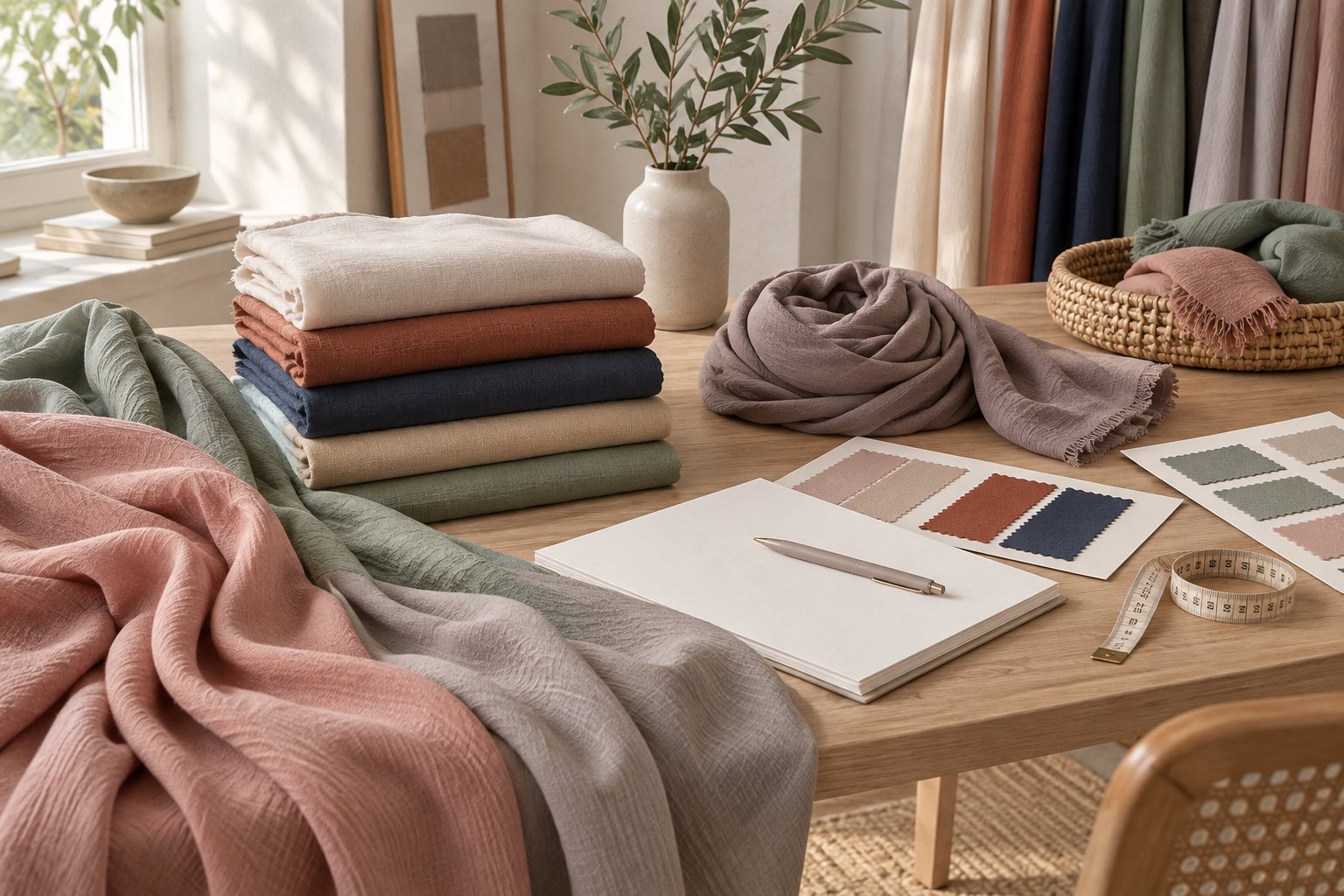
The work around the hijab
A buyer placing a first order from China usually expects the hard part to be finding a workshop. In practice, more time goes into the paperwork around the product: describing it precisely enough to quote, wording the labels, working out which tests apply, keeping colors consistent across reorders, and packing goods so the receiving warehouse accepts them. Each of these is routine for someone who does it every week, and a source of delays for someone doing it for the first time.
Support is not a separate service with its own fee schedule on this site. It is part of how a program runs, scaled to what the program needs: a boutique restocking stock colors needs little beyond reorder management, while a new brand with kids' styles and a marketplace channel needs most of it.
The desk handles that work alongside sourcing. Below is what each part involves, what we need from you, and where a decision stays with you or your advisers.
What the desk supports
| Area | What the desk does | What stays with you |
|---|---|---|
| Spec sheets | Writes the spec sheet from your brief and samples; keeps it current | Approval of each version |
| Labels | Drafts content and care wording; checks proofs against the fabric composition | RN or company name; final wording; your adviser's view |
| Test planning | Proposes which tests to consider, coordinates samples to the lab | Choice of lab and tests; compliance decisions |
| Sampling and approvals | Runs lab dips, strike-offs and sewn samples; records approvals | Approving samples |
| Inspection | Inspects against the approved sample; reports in writing | Acceptance decisions on any deviation |
| Reorders | Keeps the running spec, approved references and dye lot notes | Reorder quantities and timing |
| Channel packing | Packs and labels to your channel's written requirements | Supplying the channel's prep and labeling rules |
Writing the spec sheet
The spec sheet is the single document every other step is checked against. We write it from your brief, your reference samples and the first sampling round, and it covers fabric and composition, weight confirmed on the spec sheet, size and tolerance, edge finish, color references or print files, construction for sewn styles, label content and position, fold size, packing and carton marks. Each change gets a new version, and you approve it. When a question comes up at the workshop, the answer is either already on the sheet or added to it, so nothing depends on a chat message. The spec sheet guide shows the fields.
Label checks
Labels are small and easy to get wrong. We check that fiber names and percentages match the approved fabric composition, that viscose from bamboo is labeled as viscose or rayon "from bamboo", that the country of origin appears, that care text suits the fabric and finish, and that the RN or company name is the one you supplied. Proofs are checked again against the physical label before bulk. Whether a given scarf or cap falls under a particular labeling rule is a classification question, and we flag it for your compliance adviser rather than deciding it. See private label for label types and placement.
Test planning with labs
Some programs need laboratory testing; others are wise to do it even when not required. We help you plan which tests to consider and when, and coordinate production samples to the lab you choose. Common topics for hijab programs:
- Flammability: light and sheer fabrics sold in the United States may need testing under 16 CFR Part 1610, which classifies clothing textiles by how they burn; Class 3 fabrics may not be sold.
- Children's products: styles for children 12 and under may need third-party testing at a CPSC-accepted lab where required, a Children's Product Certificate and tracking labels.
- Performance: colorfastness, shrinkage and pilling tests, useful for reorder consistency and care instructions.
- Certificates from mills: where a mill or workshop holds a textile certificate such as OEKO-TEX STANDARD 100, we collect the certificate number so you can verify it on the issuer's label check website. The desk does not hold or claim such certificates.
Test results belong to the program and are shared with you in full. The compliance page gives an overview of the rules commonly involved.
Reorder management
Reorders should be easier than first orders, and often are not, because details are forgotten between seasons. We keep a running file for each program: the current spec sheet, approved lab dips and strike-offs, dye lot notes, label proofs, packing specification and inspection reports. A reorder starts from that file. New dye lots are checked against the original approval and the previous lot, and any change in fabric availability or workshop is raised before sampling. Plan reorders for seasonal peaks early; the Ramadan and Eid planning guide explains why.
Marketplace warehouse prep
Online sellers often ship straight from the workshop to a marketplace warehouse or a third-party logistics provider. Those warehouses have their own prep and labeling rules: unit barcodes, bag types and warnings, carton sizes and weights, and carton labels. Rules differ between marketplaces and change, so we work from the current written requirements that you send us, not from memory. We apply unit labels, bag and pack units as specified, mark cartons as instructed, and send photos and a packing list before shipment.
How to work with the desk
Replies come in writing, usually within two working days, and decisions are recorded on the spec sheet or in a confirmation. Minimums and lead times are typical reference ranges, confirmed in writing for each program on the MOQ and lead time basis. To start, send whatever you have, from a full tech pack to a photo and a target customer, through the sample request form.