
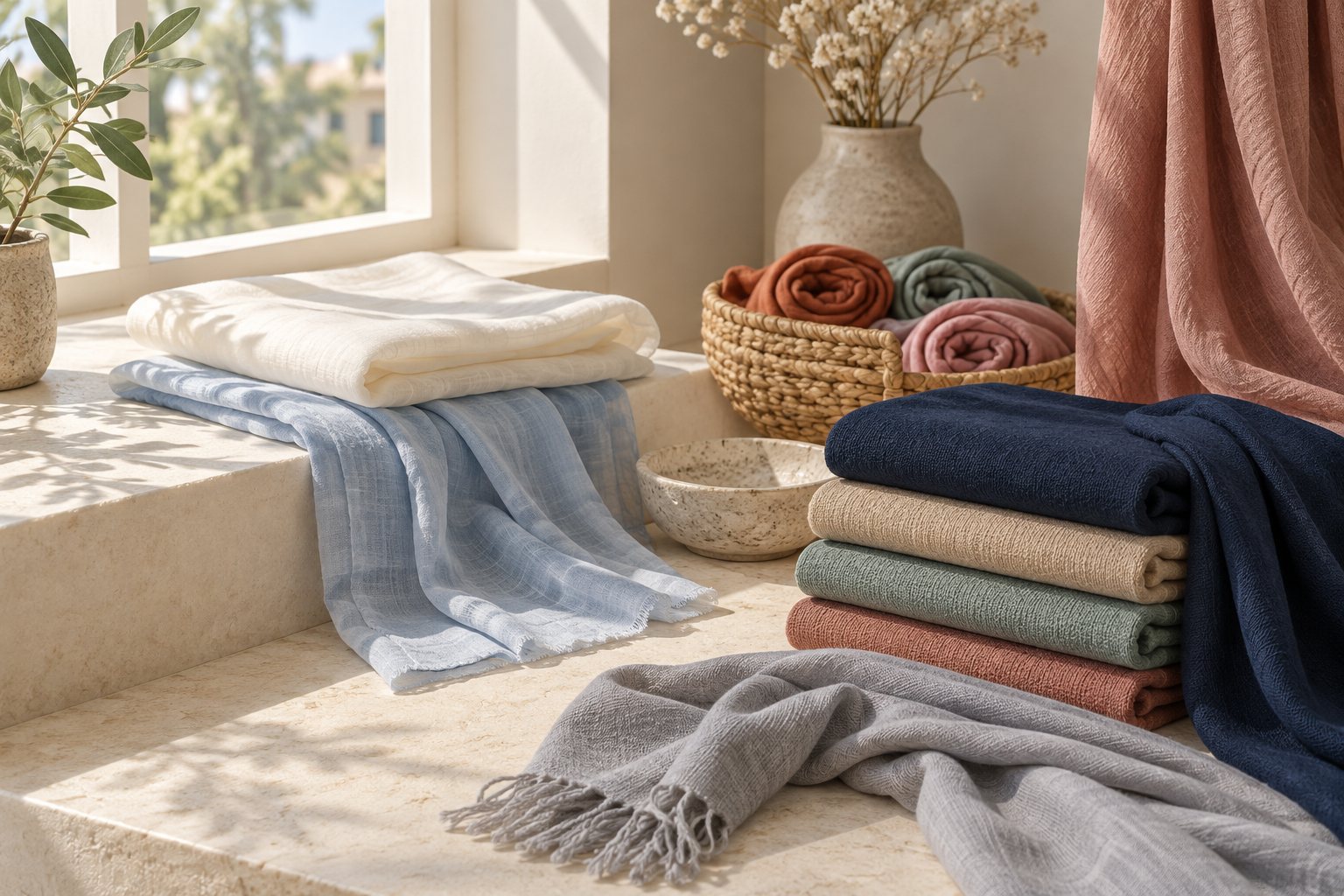
The warm-weather choice
When customers say a hijab is too hot, they usually mean the fabric does not let air or moisture through. Cotton is the natural answer. It is breathable, matte and comfortable against the skin, and it softens with washing. Cotton hijabs are a core line for stores in warm climates and a seasonal line for summer elsewhere. The trade-off is that cotton creases, can shrink, and in its lightest forms is slightly sheer.
Three cotton fabrics cover most hijab programs: voile, lawn and crinkle cotton. All are woven, and all can be plain-dyed or printed. They differ in weight, texture and how they hold a wrap.
Cotton lines suit several kinds of buyer. Stores in warm regions carry them all year. Brands elsewhere add a summer capsule of printed voile squares and plain lawn rectangles. Uniform programs for schools and workplaces often prefer cotton because it is matte, breathable and easy to launder at home. Each of these asks for something slightly different from the fabric, so the brief should name the customer and the setting, not only the color.
Voile, lawn and crinkle cotton compared
| Fabric | Hand | Opacity | Grip | Creasing | Typical use |
|---|---|---|---|---|---|
| Cotton voile | Light, soft, airy | Slightly sheer | Medium | Moderate | Printed squares and rectangles |
| Cotton lawn | Fine, smooth, a little crisp | More opaque than voile | Medium | Moderate to high | Everyday rectangles, crisp folds |
| Crinkle cotton | Textured, soft | Semi-opaque | High | Low; texture hides creases | Easy-wear rectangles, travel |
Cotton voile
Voile is a light, plain-woven cotton with an open, airy feel. It is one of the most comfortable fabrics in hot weather and a classic base for printed hijabs, especially squares, which show the full design when folded into a triangle. Voile is slightly sheer, so pale colors and light prints may need an underscarf; darker grounds cover better. Because it is light, voile also belongs in the flammability conversation for sheer scarves under 16 CFR Part 1610; we agree a test plan in writing for sheer programs, and the requirement for each item is confirmed with your compliance adviser. For more, read cotton voile hijabs for warm weather ranges.
Cotton lawn
Lawn is a fine, smooth cotton with a slightly crisper hand than voile and a little more coverage. It holds a pressed fold well, which suits wraps with defined pleats and work or uniform settings where a neat look matters. It creases more visibly than crinkle cotton, so packing and pressing instructions belong on the spec sheet.
Crinkle cotton
Crinkle cotton has a permanent puckered texture set into the fabric during finishing. The texture grips the underscarf and itself, so a crinkle wrap holds with few pins, and it hides creases, which makes it popular for travel and everyday wear. The texture also changes the measured size: a crinkle hijab is measured relaxed, and the spec sheet states how. For the texture and care side, see crinkle hijabs: texture, grip and care.
Printing on cotton
Cotton takes both digital and screen prints. Digital printing suits small runs and multicolor designs; screen printing suits larger runs with fewer colors. On light voile the print shows through to the reverse, so the reverse side is part of the approval. Custom prints typically start from about 100 pieces per design, confirmed per fabric and print method, and a strike-off on the actual cotton is approved before bulk. See custom printed hijabs.
Shrinkage, creasing and colorfastness
Cotton can shrink in the first wash if the fabric was not pre-shrunk. We ask the partner workshop to confirm the treatment and run a wash test on the approved sample, so the washed size is known before bulk. Deep colors on cotton should also be checked for color loss in washing and rubbing, especially where a dark hijab is worn over a pale garment. Creasing is part of cotton's character; lawn shows it most, crinkle least. Pressing and folding instructions, and whether pieces are packed flat or rolled, go on the spec sheet.
Edge finishes
Voile is usually finished with a rolled or baby hem, which keeps the edge light. Lawn often takes a pressed hem, which suits its crisp hand. Crinkle cotton is commonly finished with a narrow hem or overlock that does not flatten the texture near the edge. The finish and thread color are written on the spec sheet, and inspection checks hem width and straightness along the full length.
Labels and care
For the United States, the label states fiber content by generic name and percentage, so a cotton voile hijab is labeled cotton, along with the country of origin and the name or RN of the responsible company. Blends list each fiber and its share. Care instructions follow the care labeling rule where it applies; whether a given scarf is covered is a classification question for your compliance adviser. Cotton is generally easy care, but printed and deep-dyed pieces may need cooler washing, confirmed per item.
Minimums and timing
For stock cotton colors in standard styles, workshops typically start from about 50 to 100 pieces per color. Custom colors are usually higher, set by the dye lot, and custom prints typically start from about 100 pieces per design. Custom samples take about seven working days in published examples, up to around two weeks for new prints or colors; bulk typically takes about 25 to 35 days after approval, longer before Ramadan and Eid. Plan warm-weather lines well ahead of summer. All figures are typical reference ranges, confirmed in writing for each program; see MOQ and lead time and send your brief through the sample request form.