
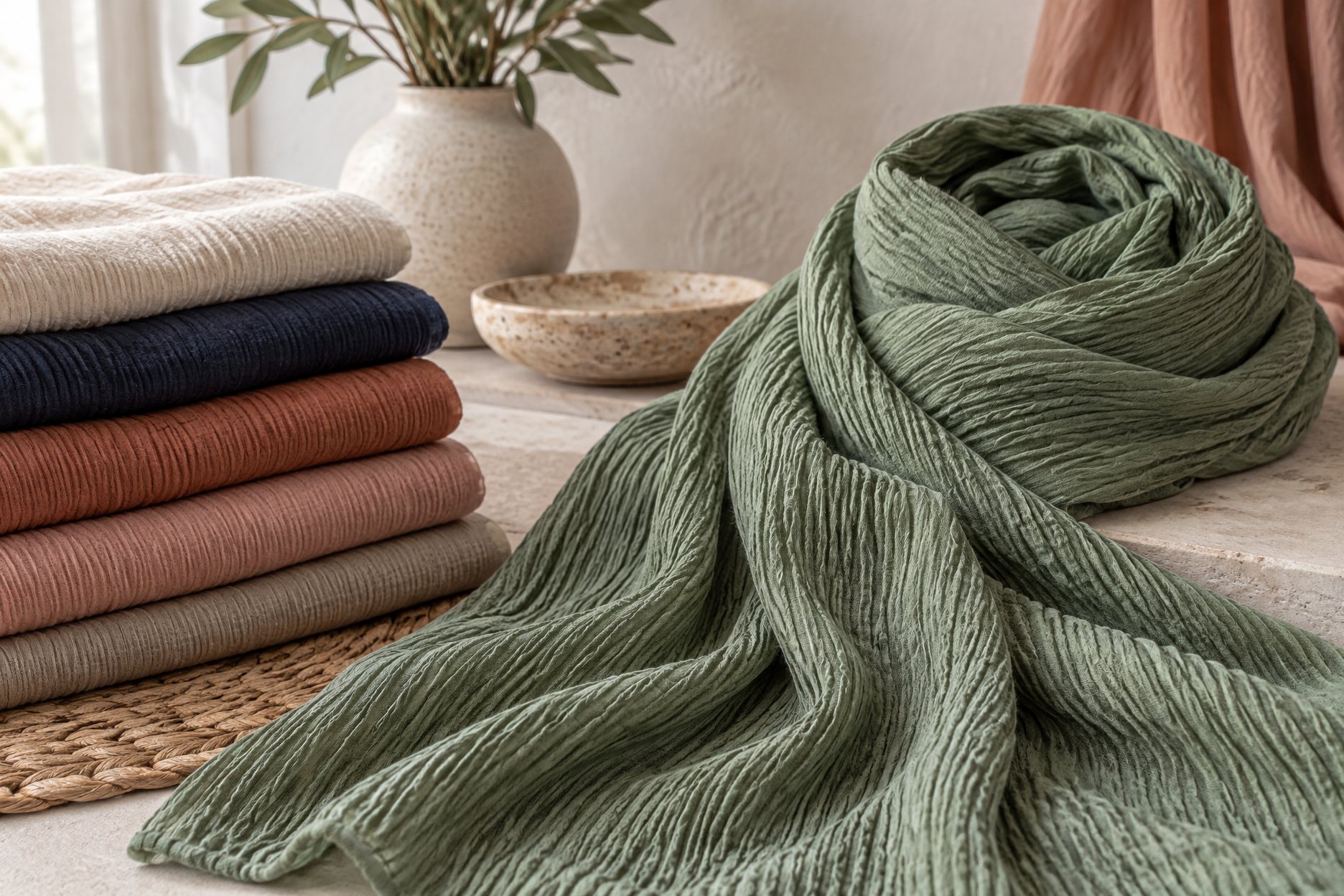
Soft drape at an everyday price point
Viscose answers a common request from buyers: something softer and more fluid than cotton, more breathable than polyester, and still suitable for everyday wear. A viscose hijab falls in heavy, soft folds and feels cool against the skin. Crinkle viscose adds a puckered texture that grips, so a wrap holds with few pins and the scarf looks fine straight out of a bag. Together they are among the most reordered lines in many ranges.
Viscose and rayon are two names for the same generic fiber family: regenerated cellulose, made by dissolving plant cellulose and spinning it into fiber. In the United States, labels use rayon or viscose as the generic name. Modal is a related fiber processed differently; for the comparison, read modal vs viscose hijab.
Plain viscose, crinkle viscose and viscose from bamboo
| Fabric | Construction | Grip | Creasing | Label fiber name |
|---|---|---|---|---|
| Plain woven viscose | Woven | Medium | Creases visibly | Viscose or rayon |
| Crinkle viscose | Woven, crinkle finish | High | Texture hides creases | Viscose or rayon |
| Viscose jersey | Knit | High | Low | Viscose or rayon |
| Viscose from bamboo | Usually knit | High | Low | Rayon or viscose from bamboo |
How crinkle works
Crinkle texture is set into the fabric during finishing, giving a fine, irregular pucker across the surface. On a hijab, that texture does three useful things. It grips the underscarf and itself, so wraps hold with fewer pins. It hides creases, so the scarf looks right after travel or a day in a bag. And it adds visual depth to plain colors. The texture also affects size: a crinkle hijab is measured relaxed, and the spec sheet states the method so inspection compares bulk with the approved sample on the same basis. Crinkle is also made in cotton; see cotton hijabs and crinkle hijabs: texture, grip and care.
Shrinkage and wet strength
Viscose can shrink noticeably in the first wash if the fabric was not pre-treated, and it is weaker when wet, so rough handling in the wash can distort it. We ask the partner workshop to confirm the treatment and run a wash test on the approved sample, so the washed size is known before bulk. The care card should match what the wash test supports, typically a gentle wash and drying flat; final care instructions are confirmed per item. Crinkle texture can relax with hot washing or pressing, which is another reason to put care instructions in writing.
Sheer weights and flammability
Light, sheer viscose scarves have a specific history. In 1995 the CPSC announced a recall of about 375,000 sheer rayon chiffon scarves, and 16 CFR 1610.61 notes that violative sheer rayon and silk scarves were found between 1994 and 1998. Clothing textiles in the United States fall under 16 CFR Part 1610, which classifies fabrics in a 45-degree flame test into Class 1, 2 or 3; Class 3, rapid and intense burning, may not be sold. Heavier viscose and crinkle viscose behave differently from sheer weights, but weight, construction and finish all affect the result.
Bamboo: labeled as viscose or rayon from bamboo
Hijabs sold as bamboo are almost always made from viscose produced from bamboo pulp. The bamboo plant is the cellulose source, but the fiber is regenerated cellulose, the same generic fiber as other viscose. Under FTC rules, the label and the marketing must use the generic fiber name, for example rayon from bamboo or viscose from bamboo, not bamboo on its own. The FTC has taken enforcement action against sellers who marketed rayon textiles as bamboo, so this is a point to get right before launch.
In practice that means three things line up: the fiber content on the sewn label, the product name and description on your store, and any claims on hang tags or packaging. Environmental or softness claims tied to bamboo need their own substantiation; we suggest buyers keep claims factual and check them with a compliance adviser. For detail, read bamboo hijabs: viscose from bamboo and label rules.
Labels for viscose hijabs
For the United States, the label states fiber content by generic name and percentage, the country of origin and the name or RN of the responsible company. Blends with spandex, cotton or polyester list each fiber and its share. Care instructions follow the care labeling rule where it applies; whether a given scarf is covered is a classification question for your compliance adviser.
Edge finishes
Plain woven viscose usually takes a rolled or baby hem. Crinkle viscose is often finished with a narrow hem or overlock that keeps the texture intact near the edge. Viscose jersey and bamboo-derived jersey are usually overlocked. The finish and thread color go on the spec sheet and are checked at inspection.
Minimums and timing
For stock viscose and crinkle colors in standard styles, workshops typically start from about 50 to 100 pieces per color. Custom colors are usually higher, set by the dye lot. Custom samples take about seven working days in published examples, up to around two weeks for new colors; bulk typically takes about 25 to 35 days after approval, longer before Ramadan and Eid, plus time for flammability testing where your adviser recommends it. All figures are typical reference ranges, confirmed in writing for each program; see MOQ and lead time.
When you send the brief, name the construction you want (plain, crinkle or jersey), the fiber source if bamboo is part of the story, and the colors per style. The first reply confirms the label wording alongside the sampling plan, so the bamboo question is settled before artwork for tags and packaging is printed.