
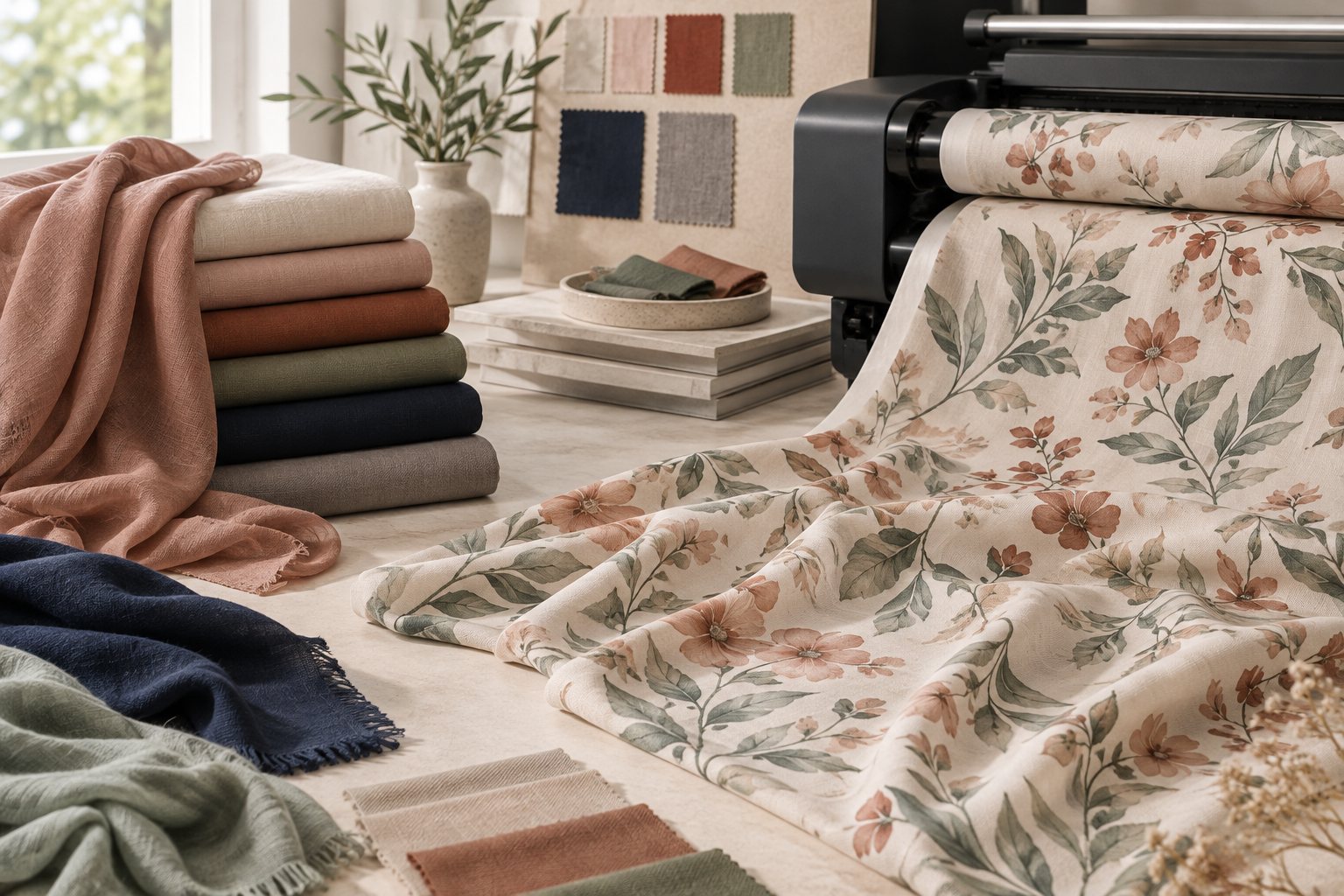
Where printed programs go wrong
Printed hijabs fail in predictable ways. The colors on the scarf are duller than the colors on the screen. The border sits closer to one edge than the other after hemming. A fine line pattern blurs on chiffon. A design that looked balanced as a flat file looks crowded once the scarf is folded and worn. None of these are hard to fix, but each needs to be caught on a strike-off, not on finished stock.
This page explains how a custom print program runs through partner workshops in the Yiwu cluster, which methods and fabrics suit which designs, and what to send so the first strike-off is close to right.
Digital or screen print
Both methods are widely run in the cluster. The choice depends on the number of colors in the design, the quantity per design and the fabric.
| Factor | Digital print | Screen print |
|---|---|---|
| How it works | Ink applied by print heads directly from a digital file | Ink pushed through a separate screen for each color |
| Colors per design | Many colors, gradients and photographic detail | Best with a limited number of flat colors |
| Run size | Suits small runs and many designs | Suits larger runs of fewer designs |
| Setup | No screens; changes to the file are simple | Screens made per color; changes mean new screens |
| Look and feel | Fine detail; color depth depends on fabric and fixing | Solid, saturated flat colors |
| Typical use | Seasonal capsules, florals, test designs, varied palettes | Repeat bestsellers, geometric or logo designs |
Many brands start digital to test designs in small quantities and move a proven design to screen print when volumes justify the screens. Where a design suits both, we quote both so you can compare.
Fabrics that print well
- Modal: soft, breathable and a reliable base for detailed digital prints; a common choice for premium printed rectangles and squares. See modal hijabs.
- Chiffon: light and semi-sheer; prints carry well, though fine lines can soften, and the print shows on both sides with a lighter reverse.
- Cotton voile: matte, light and breathable; good for warm-weather printed squares.
- Satin: sheen lifts color for evening and Eid lines; slippery to cut, so placement needs care.
Fabric also changes how a print reads once worn. A busy pattern on a light chiffon softens as layers overlap, while the same pattern on a matte voile stays crisp. If one design will run on two fabrics, we strike off on both, because colors and line quality will differ between them and each needs its own approval.
Jersey can be printed too, but stretch can distort placement and some designs look different when the knit is pulled. Whatever the fabric, the strike-off is made on the production fabric, not a substitute.
Artwork files
Good files save a round of strike-offs. Send:
- The design at the finished size of the scarf, plus hem allowance, or a repeat tile with its repeat size stated.
- For digital print, a high-resolution file with layers kept where possible; for screen print, separated colors or vector artwork.
- A placement note: which corner is the top, where borders sit, what must stay visible when the scarf is folded into a triangle.
- Color references for key colors as physical swatches or color standard numbers, not only screen colors.
If you have an idea but not finished artwork, we can describe what a print workshop will need, but design work itself stays with you or your designer.
Strike-offs and color matching
A strike-off is a printed sample of your design on the production fabric. It shows real colors, line quality and placement. You approve or comment, and the printer adjusts. Screen color and printed color always differ, because fabric absorbs ink and a screen emits light, so key colors are matched to physical references. Expect one or two rounds for a new design. Custom samples take about seven working days in published examples, up to around two weeks for new prints. Read sampling, lab dips and strike-offs for the full sequence.
Placement on squares and rectangles
Placement matters more on hijabs than on most printed goods, because the scarf is folded and wrapped. A square folded into a triangle shows two borders and one corner most of the time; a rectangle shows the ends and one long edge. We ask where the visual weight should sit, check border widths on the strike-off after hemming, and record placement on the spec sheet. Printed borders also need to match the edge finish: a rolled hem takes a little fabric, so borders are drawn with the hem allowance in mind.
Minimums and timing
Custom prints typically start from about 100 pieces per design, confirmed per fabric and print method. Screen printing may need more per design to justify screens; digital printing can sometimes go lower on some fabrics. A colorway, meaning the same design in a different set of colors, usually counts as a separate design for minimums. Bulk typically takes about 25 to 35 days after strike-off and sample approval, longer before Ramadan and Eid. These are typical reference ranges, confirmed in writing for each program on the MOQ and lead time basis.
Care and colorfastness
Printed scarves are washed and worn often. Colorfastness to washing and rubbing, and shrinkage, can be tested at a lab where your standards call for it, and care instructions follow the fabric and print. Light printed fabrics sold in the United States may also need flammability testing under 16 CFR Part 1610; we plan that with you where it applies. Send your design files with the sample request form and the first reply will propose a method, a fabric and a strike-off plan.