
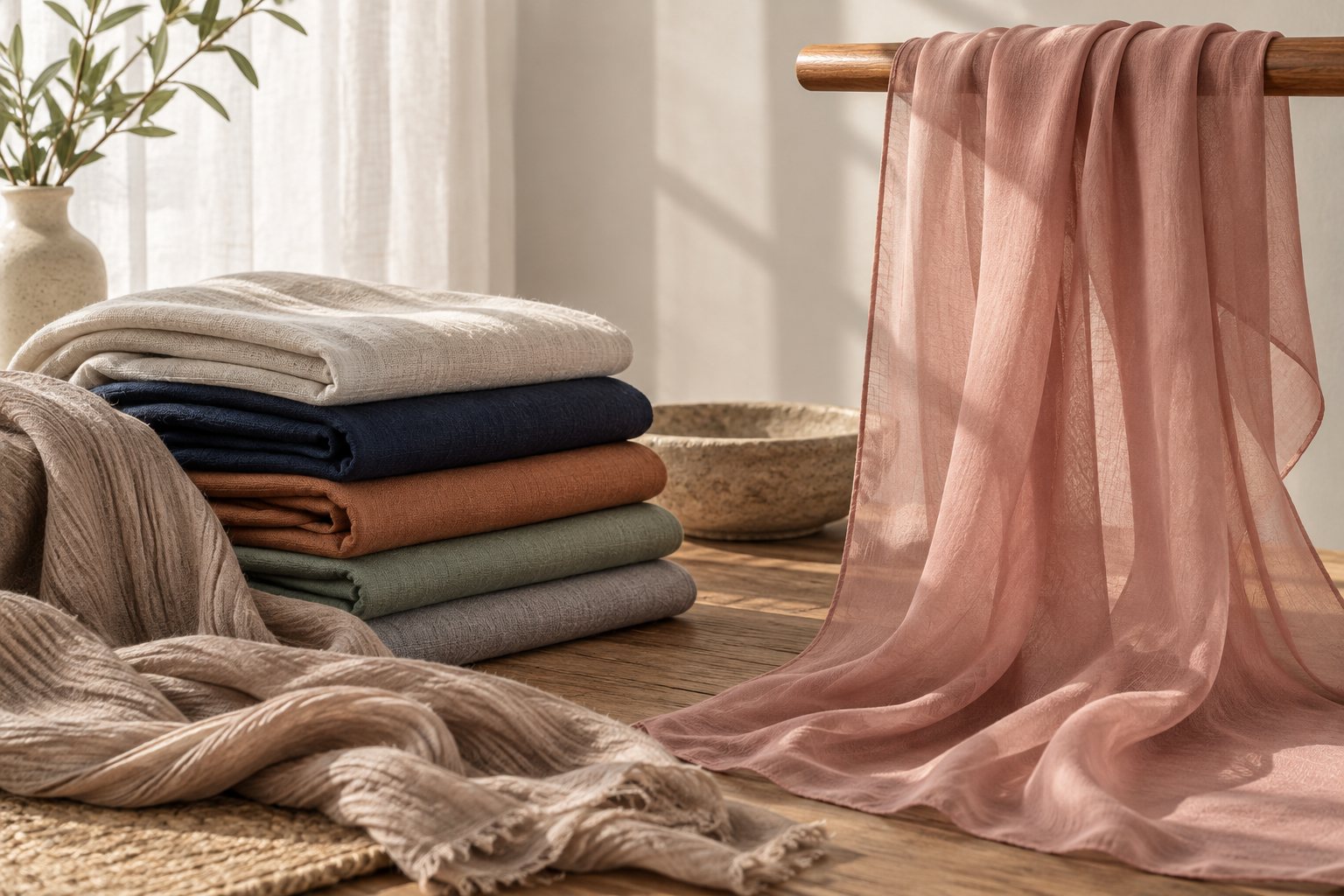
Why chiffon sells, and why it gets returned
A chiffon hijab floats. It drapes into soft folds, layers well and catches light, which is why it is a favorite for events, weddings, Eid and any day a wearer wants a dressier look. The same lightness causes the common complaints: it slides on the head, it shows the underscarf through it, and the edges snag on jewelry and bag straps. Buyers who sell chiffon well are the ones who plan for all three, and who pair the hijab with a matching underscarf.
Chiffon is a woven fabric made from highly twisted yarns, which gives it a slightly rough, matte or soft-sheen surface. Most hijab chiffon is polyester, which holds dye well and resists creasing. Crepe chiffon and georgette are heavier, more textured relatives with a little more grip and more coverage.
Types of chiffon for hijabs
| Type | Surface | Opacity | Grip | Typical use |
|---|---|---|---|---|
| Polyester chiffon | Smooth, soft sheen | Sheer | Low | Layered and event styles |
| Crepe chiffon | Fine pebbled texture | Semi-sheer | Medium | Everyday dressy rectangles |
| Georgette | Grainy, matte, heavier | Semi-sheer to near opaque | Medium | Rectangles, khimars, niqab layers |
| Printed chiffon | As base fabric | As base fabric | As base fabric | Seasonal prints, squares |
For a first chiffon line, crepe chiffon is often the practical middle: enough texture to hold a pin, enough body to cover, light enough to feel like chiffon. Sheer polyester chiffon suits layered and evening styles where the underscarf is part of the look.
Opacity and the underscarf
Chiffon is sheer to semi-sheer, so many wearers pair it with an underscarf in a matching or contrasting color. That pairing is also a range opportunity: a chiffon rectangle sold with a jersey underscarf in the same shade solves the see-through problem and lifts the basket. Matching color across a woven chiffon and a knit jersey is harder than it sounds, because the two fabrics take dye differently, so we run lab dips on both fabrics together. See underscarves and caps.
Weight changes opacity more than any other factor. We confirm the weight on the spec sheet against the approved sample and check it in daylight, rather than relying on a fabric name.
Hems and edge finishes
Chiffon frays, so the edge finish is part of the product. A rolled or baby hem gives the light, clean edge most buyers expect; it is narrow and sits softly at the face. Overlock is faster but heavier and more visible on sheer fabric. Pressed hems are less common on chiffon. The finish, the thread color and the stitch density go on the spec sheet, and inspection checks for puckering, skipped stitches and uneven width along the length.
Flammability: why sheer scarves need a test plan
Light, sheer scarves are the products most associated with flammability failures in clothing textiles. In the United States, clothing textiles fall under the Flammable Fabrics Act and the standard at 16 CFR Part 1610. The test holds a fabric specimen at 45 degrees, applies a flame and times how fast it burns. Fabrics are placed in Class 1, 2 or 3; Class 3, rapid and intense burning, may not be sold for clothing.
The history explains why buyers take this seriously. In 1995 the CPSC announced a recall of about 375,000 sheer rayon chiffon scarves that failed the standard, and the regulation itself notes that violative sheer rayon and silk scarves were found between 1994 and 1998. Polyester chiffon is a different fiber, but weight, construction and finish still affect the result, so we do not assume a pass for any sheer fabric.
Labels and care
Chiffon labels state fiber content by generic name and percentage, so a polyester chiffon hijab is labeled polyester, along with country of origin and the name or RN of the responsible company. Care instructions follow the care labeling rule where it applies; whether a given scarf is covered is a classification question for your compliance adviser. Chiffon generally tolerates a gentle wash, but snags easily, so many brands suggest a wash bag on the care card.
Prints on chiffon
Polyester chiffon takes digital prints well, which suits small runs of seasonal designs. Because the fabric is sheer, the print shows on both sides with a lighter reverse, and fine detail can soften. A strike-off on the actual chiffon is the only reliable check. Custom prints typically start from about 100 pieces per design, confirmed per fabric and print method.
Plain chiffon in a wide palette is also a common strategy. Because chiffon is often layered, customers buy several shades to combine with underscarves and outfits, so a chiffon line tends to be broader in color and shallower per color than a jersey line. That shape of order affects minimums, which are counted per color, so plan the palette with the reference ranges in mind.
Minimums and timing
For stock chiffon colors in standard styles, workshops typically start from about 50 to 100 pieces per color; custom colors dyed to your reference are usually higher, set by the dye lot. Custom samples take about seven working days in published examples, up to around two weeks for new prints or colors, and bulk typically takes about 25 to 35 days after approval, longer before Ramadan and Eid. Add time for flammability testing where your adviser recommends it. All of these are typical reference ranges, confirmed in writing for each program; see MOQ and lead time, then send your brief through the sample request form.