
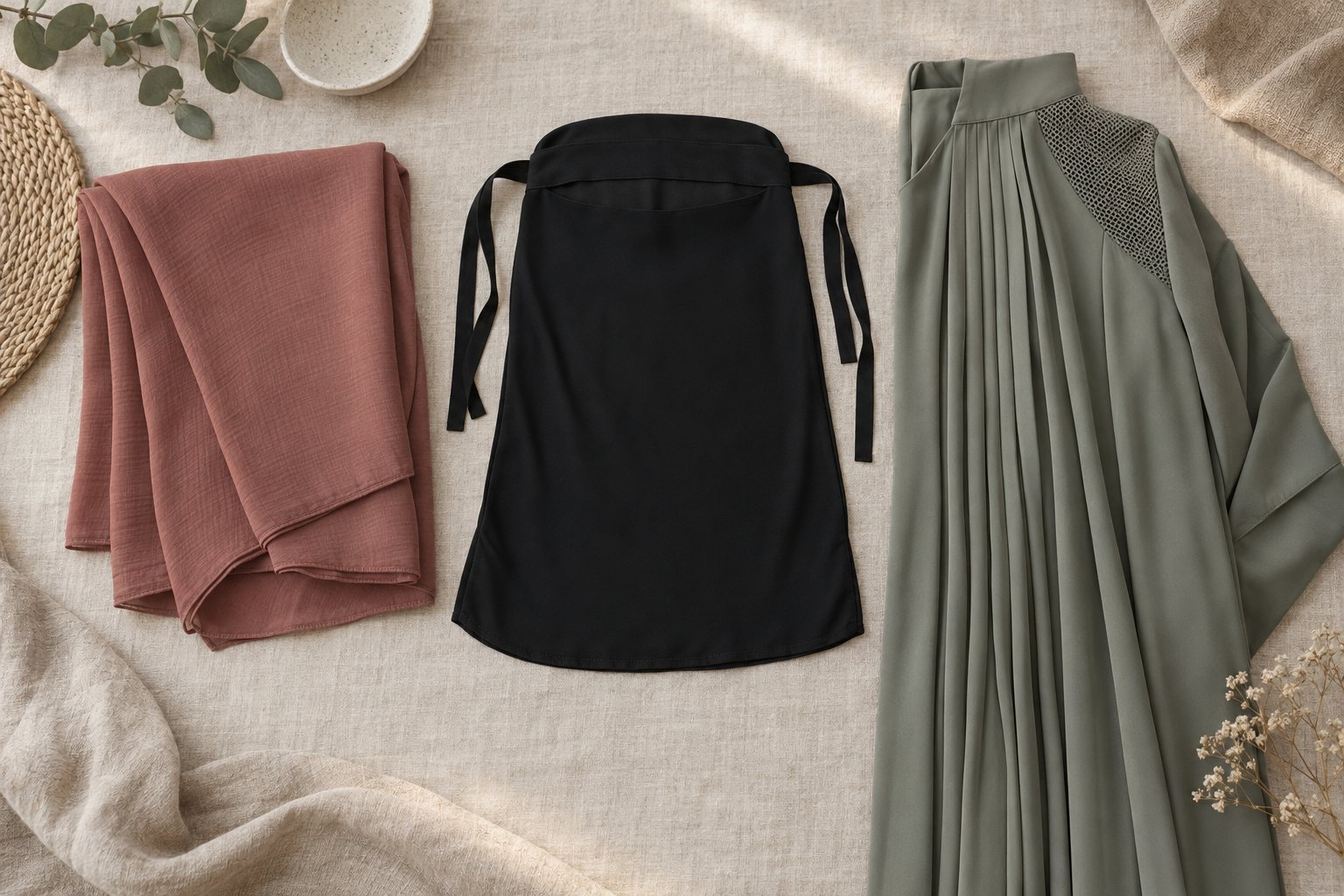
Why the words get mixed up
Search for burka vs hijab or hijab vs niqab and you find many confident answers that do not agree. Part of the reason is that the words travel. A term used for one garment in one region can mean a different garment somewhere else. Another part is that hijab is used in two ways: for a specific headscarf and, more broadly, for modesty itself. And many garments are worn in combination, so a photo of one garment often shows two or three.
This guide describes garments: what each one usually covers and what it is usually made of. It does not rank them or say who should wear what. Practice varies by person, family, community, region and school of thought, and many wearers move between styles depending on the occasion.
The garments side by side
| Term | What it usually covers | Face | Typical fabrics |
|---|---|---|---|
| Hijab | Hair, neck and often the chest; a headscarf in many shapes | Visible | Jersey, chiffon, modal, cotton voile, viscose, satin |
| Al-amira | Hair and neck; two pieces, a cap plus a tube-style scarf | Visible | Jersey, viscose jersey |
| Shayla | Hair and neck; a long rectangle wrapped and tucked or pinned at the shoulders | Visible | Chiffon, crepe, georgette |
| Khimar | Hair, neck, shoulders and chest; cape-like, often to the waist or longer | Visible | Nida, crepe, jersey, chiffon |
| Chador | Head and body; a full-length open cloak held closed by hand | Visible | Light woven fabrics, often dark |
| Niqab | The face, leaving the eyes visible; worn with a headscarf | Covered, eyes visible | Nida, chiffon, crepe |
| Burqa (burka) | In its best-known form, the whole body and face, with a mesh panel at the eyes; in some regions a face covering | Covered, mesh panel in the full-length form | Light polyester, crepe, nida |
Hijab
As a garment, a hijab is commonly a headscarf covering the hair, neck and often the chest, with the face visible. It comes in many shapes: a rectangle wrapped and pinned, a square folded into a triangle, an instant slip-on style, or layered over an underscarf. As a word, hijab is also used more broadly for modesty in dress and behavior, which is why some sources use it as an umbrella for all of the garments on this page. When a customer says hijab, they almost always mean the headscarf. See hijab styles.
Hijab vs niqab
The difference is the face. A hijab leaves the face visible; a niqab is a face veil that leaves the eyes visible. They are not alternatives so much as layers: a niqab is worn with a headscarf, so someone wearing a niqab is usually wearing a hijab or khimar as well. Niqabs come in single-layer, multi-layer and tie-back styles, most often in matte nida. See niqabs.
Burka vs hijab
A hijab is a headscarf; a burqa, also spelled burka, is in its best-known sense a garment covering the whole body and the face, with a mesh or grille panel at the eyes. The Afghan chadari is the example most people have in mind: a full-length garment hanging from a fitted cap, falling in fine pleats. In some regions, though, the word burqa refers to a face covering rather than a full-length garment, so the same word can describe quite different items. A useful test is to ask what is covered and how the wearer sees: through a mesh panel, through an eye opening, or with the face visible. See burqas.
Niqab vs burqa
Both cover the face, which is why they are often confused. A niqab leaves the eyes visible through an opening and is worn with a separate headscarf. The full-length burqa covers the eyes with a mesh panel and is one garment from the head down. Where the word burqa is used for a face covering, the difference narrows to regional construction and naming. Our posts on what a niqab is and what a burqa is go further.
Khimar, shayla, al-amira and chador
Khimar
A khimar is a longer, cape-like headcovering that falls over the shoulders and chest, often to the waist or longer. It slips on over the head and usually has a shaped opening for the face. It is often made in nida or crepe, and sometimes sold with a matching niqab.
Shayla
A shayla is a long rectangular scarf, wrapped around the head and tucked or pinned at the shoulders. It is associated with Gulf styles and is often made in light chiffon or crepe, usually over an underscarf.
Al-amira
An al-amira is a two-piece slip-on: a close-fitting cap and a tube-style scarf pulled over it. It needs no pins and is popular for everyday wear, school and sport.
Chador
A chador is a full-length open cloak, held closed by hand, associated with Iran. It covers the head and body and leaves the face visible. We explain it here as a term; it is not a core product of the desk.
Practice varies
None of these garments has one fixed meaning everywhere. The same person may wear a jersey hijab for work, a chiffon shayla for an event and a niqab on other occasions. Families, communities and regions have their own conventions, and schools of thought differ. Rules on face coverings in public places vary by country and change over time. For buyers, the practical lesson is to describe products by what they are and how they are made, and to let customers decide what suits them.
For buyers building a range
Clear terms on product pages reduce returns and questions. Name the garment, describe what it covers, give the length and fabric, and show it laid flat. If you are building a range across several of these styles, we coordinate them through partner workshops that sew each one; typical minimums and timelines are on MOQ and lead time.