
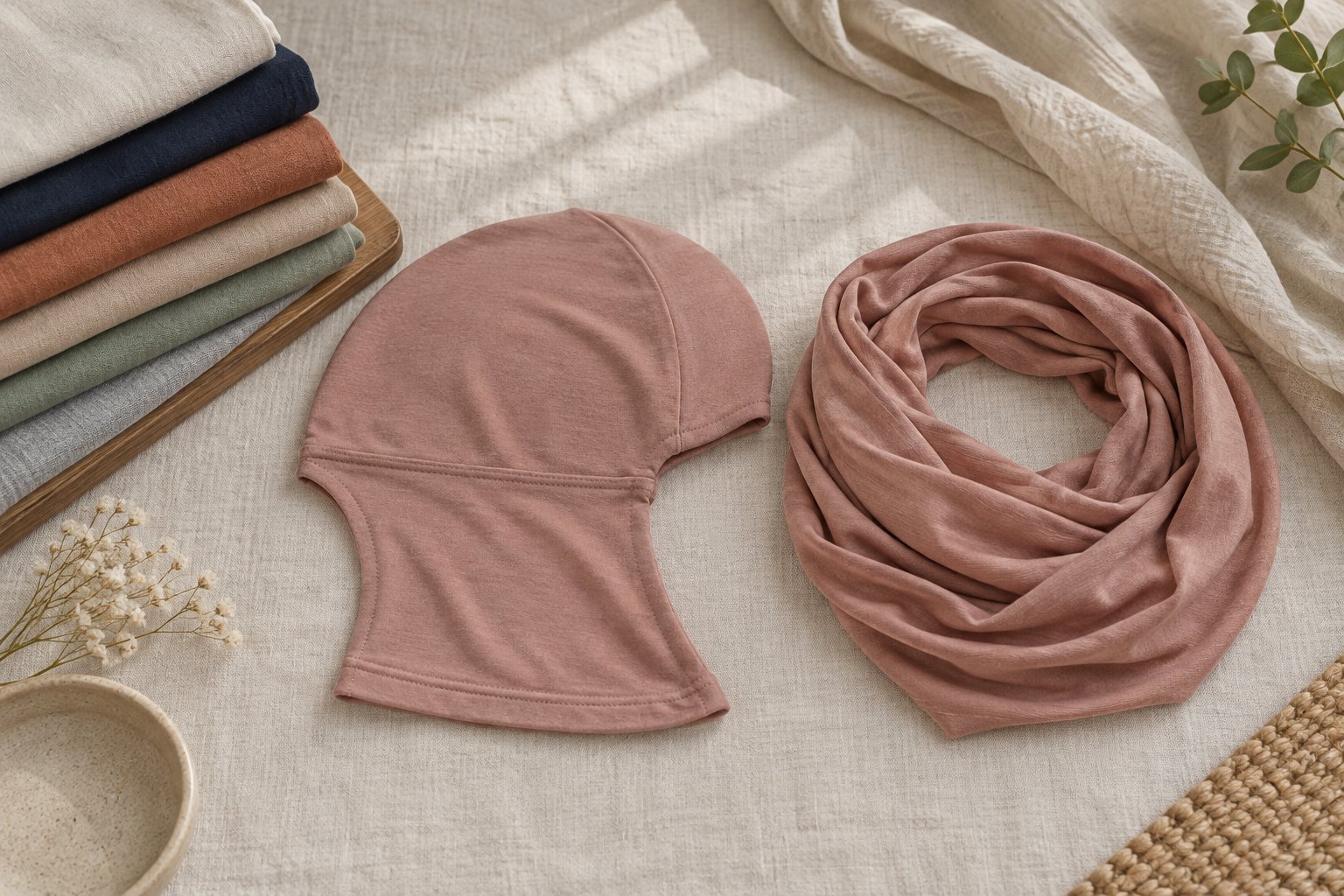
Why stores stock the al-amira
Some customers want a hijab that goes on in seconds and stays put without pins or wrapping. The al-amira answers that with two pieces: a cap that holds hair and grips, and a tube that slips over the head and falls over the neck and shoulders. Many wearers keep one for quick errands, prayer or home; schools and community stores stock them because they are easy to size and easy to explain. For a buyer, the al-amira is a dependable line in core colors, with seasonal shades and trims added once the base sells.
How the two pieces are built
| Piece or variant | Construction | Points to specify |
|---|---|---|
| Cap | A tube or bonnet-style cap in stretch knit | Cap circumference relaxed and stretched, depth, band finish |
| Tube scarf | A knit tube with an opening for the face, falling over neck and shoulders | Opening size, length at front and back, hem finish |
| Long tube variant | A longer tube that reaches the chest or below | Front and back length, weight confirmed on the spec sheet |
| One-piece amira | Cap and tube joined at the front band | Join seam, band width, opening |
| Trimmed variant | Lace edge, printed band or small embroidery on the tube | Trim type, placement, attachment, extra steps in lead time |
The cap in an al-amira set is the same kind of garment sold separately as an underscarf. If your range already includes caps, look at hijab caps and underscarves and consider using the same cap pattern for both lines to keep fit consistent.
Fabrics
Al-amira sets are almost always knit. Cotton jersey is matte and breathable, with a slight grip. Viscose jersey has a softer drape and a cool feel. Cotton-spandex is often used for the cap because it holds tension well. Some ranges use a heavier knit for the tube in cooler seasons and a lighter one in summer; the weight is confirmed on the spec sheet, and the tube is checked for opacity on the sewn sample, stretched over a form. The jersey hijabs page explains how the knits differ in feel and care.
Sizing
An al-amira is usually sold in one adult size, sometimes with a larger size or a long version, and in separate kids' sizes. The cap circumference, the tube opening and the front and back lengths decide whether it fits comfortably and covers the way your customers expect. We write each measurement with a tolerance and check the sample after a wash, because knits can relax or shrink and the opening is where that shows first.
- Opening: the tube opening is the most sensitive measurement; too tight is uncomfortable, too loose and the tube shifts.
- Lengths: state front and back lengths separately; many customers want the back longer.
- Cap depth: a shallow cap can slide back; the depth is agreed on the sample.
Matching the two pieces
Customers notice when the cap and the tube are two slightly different shades. If both pieces are cut from the same fabric and dye lot, matching is straightforward. If the cap is cotton-spandex and the tube is viscose jersey, the two fabrics take dye differently and need lab dips approved together. Some ranges choose a deliberate contrast, such as a black cap under a colored tube, which avoids the matching question and makes a clear design point. Either way, the choice is written on the spec sheet before dyeing.
Trims and decoration
Lace edges, printed bands, small embroidery and rhinestone details are popular in gift and Eid ranges. Each adds a step and can change the minimum and the timeline. For adult ranges the main checks are attachment strength and comfort where the trim touches skin. For kids' sizes, trims raise children's product questions such as lead limits and small parts, which is why kids' al-amira sets are usually kept plain or use printed rather than attached decoration. See kids' hijabs for the rules that apply.
Packing sets
An al-amira is sold as a set, so the two pieces should travel together. The usual pack is the tube folded with the cap inside or on top, in a polybag with a size sticker and barcode. Gift ranges use a card sleeve or small box. Multipacks of several colors are popular in stores. Pack type, inserts and carton counts are confirmed on the spec sheet; the note on hijab packaging options lists what workshops typically offer.
Inspection points
Inspection on an al-amira program checks each piece and the set together. Inspectors measure the cap and tube against the spec sheet, check the tube opening for stretch and recovery, pull-test the seams at the opening and the cap band, compare the shade of cap and tube under the same light, and confirm that every bag holds a matching pair in the right size. Trims are checked for secure attachment and placement. Faults found at this stage are sorted and reworked before packing, and the results are shared with you in writing before the cartons are closed.
Labels and care
For the United States, each set generally needs fiber content by generic name and percentage, country of origin and dealer identity, plus care instructions. If the cap and tube are different fabrics, each piece needs its own fiber content. Whether a cap is classed as headwear for any exemption is a classification question for your compliance adviser.
MOQ and lead time
For stock colors in standard al-amira styles, workshops typically start from about 50 to 100 sets per color. Custom colors are dyed by lot and usually need more; trims and prints add sampling steps. Samples take days for stock styles and about seven working days to two weeks for new colors, and bulk typically runs about 25 to 35 days after approval, longer before Ramadan and Eid. These are reference ranges, confirmed in writing for each program; see MOQ and lead time and send your sizes and colors through the sample request form.