
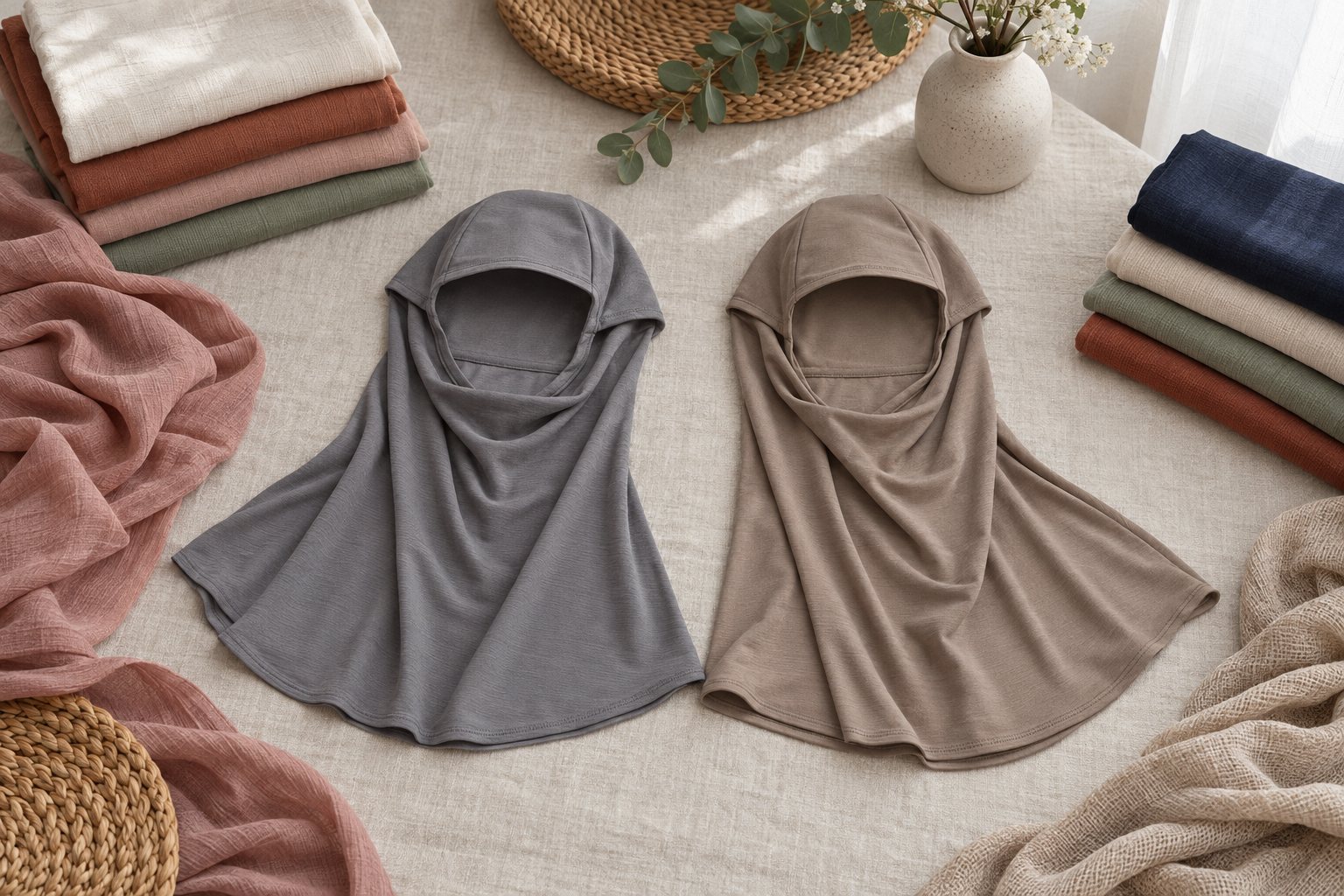
The problem an instant hijab solves
Many wearers wrap and pin a rectangle hijab every morning. It takes practice, a mirror and a few minutes, and the result shifts through the day. An instant hijab removes most of that work: the shape is sewn in, so the wearer slips it on, adjusts the front and goes. Customers who are new to wearing a hijab, parents buying for older children, people on early shifts and people who travel often reach for instant styles first. For a store, they are dependable sellers in neutral colors and an easy reorder.
The trade-off is that an instant hijab is a sized, constructed garment rather than a flat scarf. A rectangle that is a few centimeters longer than planned still works; an instant hijab with an opening that is too tight or a back that is too short is a return. That is why the spec sheet for an instant style carries more measurements than the spec sheet for a plain scarf.
Constructions buyers ask for
"Instant hijab" covers several constructions. Naming the one you want avoids a sample that looks right in a photo but wears differently.
| Construction | How it is built | Points to specify |
|---|---|---|
| One-piece slip-on | A single knit piece sewn into a hood shape with a front opening | Opening size, front band width, back and chest length |
| Two-piece (al-amira) | A separate cap plus a tube-style scarf | Cap circumference, tube length, matching shade across pieces |
| Pre-sewn wrap | A rectangle with a sewn section that sets the drape; one end wraps | Where the seam sits, wrap length, whether a pin is still needed |
| Built-in cap style | An inner cap layer sewn to an outer scarf layer | Inner cap fabric, how the layers are joined, total weight on the spec sheet |
| Tie-back instant | A slip-on with ties at the back for adjustment | Tie length and finish, how the ties are anchored |
The two-piece style has its own page, al-amira hijabs, because it is often bought as a separate line with its own sizes.
Fabrics that work for instant styles
Most instant hijabs are knit, because a knit stretches over the head and recovers without fasteners. Cotton jersey is matte and breathable. Viscose jersey drapes more softly and feels cool. Modal jersey is smooth and prints well, which suits custom ranges. Cotton-spandex holds its shape and grips, so it is common for the inner cap section of built-in styles. Woven fabrics such as chiffon appear on dressier instant styles, usually as an outer layer sewn over a jersey base, since chiffon alone is slippery and does not stretch. Read the fabric notes in jersey hijabs before choosing.
Weight matters more for an instant hijab than for a wrapped scarf, because the wearer cannot add or remove a layer. A light knit can look sheer once it stretches over the head; a heavy one can feel warm. We confirm weight on the spec sheet and check opacity on the sewn sample, stretched, not only on flat fabric.
Fit, sizing and the measurements that matter
An instant hijab is sized by a small set of measurements: the opening, the front band, the length at the back and the length at the front or chest. Many ranges sell one size, some offer two or three, and kids' versions are sized separately. Whatever the plan, we write each measurement on the spec sheet with a tolerance, and measure the sample relaxed and gently stretched so you know how it will behave on the shelf and when worn.
- Opening: too tight is uncomfortable; too loose slides. Stretch and recovery of the knit decide the right number.
- Front band: a doubled or elasticated band holds the shape; specify width and whether elastic is enclosed.
- Back and chest length: many customers want the chest covered; state the length you want rather than relying on the workshop's usual pattern.
- Seams: seams that sit at the forehead or the ears need to be flat and soft. Ask for flatlock or covered seams where they touch skin.
For a wider view of sizes across styles, see the hijab sizing guide.
Edge finishes and details
Instant styles usually have an overlocked or coverstitched edge. Some knits can be laser cut, which leaves a clean flat edge, but a cut edge on a stretched area can curl, so we test it on the sample before agreeing it for bulk. Decorative details such as a printed band, a small embroidered motif or a contrast trim are possible; they add steps and can change the minimum, so they belong in the brief from the start.
Where instant hijabs go wrong
Most complaints about instant styles come from a few causes, and each one can be written into the inspection plan.
- Size drift. Knits relax or shrink after washing. We ask for the fabric to be pre-treated where possible and include a wash check on the sample.
- Crooked shape. If the pattern pieces are cut off-grain, the hijab twists when worn. Inspection checks symmetry on a form.
- Shade mismatch. Two-layer styles need both layers dyed to the same reference, or a planned contrast.
- Weak stitching at stress points. The opening and the band take the most strain; inspectors pull-test them.
Labels, care and compliance
For the United States, an instant hijab is generally treated like other textile apparel: fiber content by generic name and percentage, country of origin and the dealer's identity under the Textile Act rules, plus care instructions under the FTC Care Labeling Rule. Whether a particular style is classed as headwear for any exemption is a question for your compliance adviser. If a style uses a sheer outer layer, plan a flammability test under 16 CFR Part 1610. Sizes intended for children 12 and under fall under separate children's product rules; see kids' hijabs.
MOQ, samples and planning a range
For stock colors in standard instant styles, workshops in the Yiwu cluster typically start from about 50 to 100 pieces per color and style. Custom colors run by dye lot and are usually higher; custom prints typically start from about 100 pieces per design. Samples ship in days for stock styles and take about seven working days to two weeks for a new color or print, and bulk typically runs about 25 to 35 days after sample approval, longer before Ramadan and Eid. All of these are reference ranges, confirmed in writing for each program on the MOQ and lead time page.
A practical first range pairs one instant style in a core palette of neutrals with a matching underscarf, then adds seasonal shades once reorder patterns are clear. When you are ready, send your sizes, fabric preference and colors through the sample request form.