
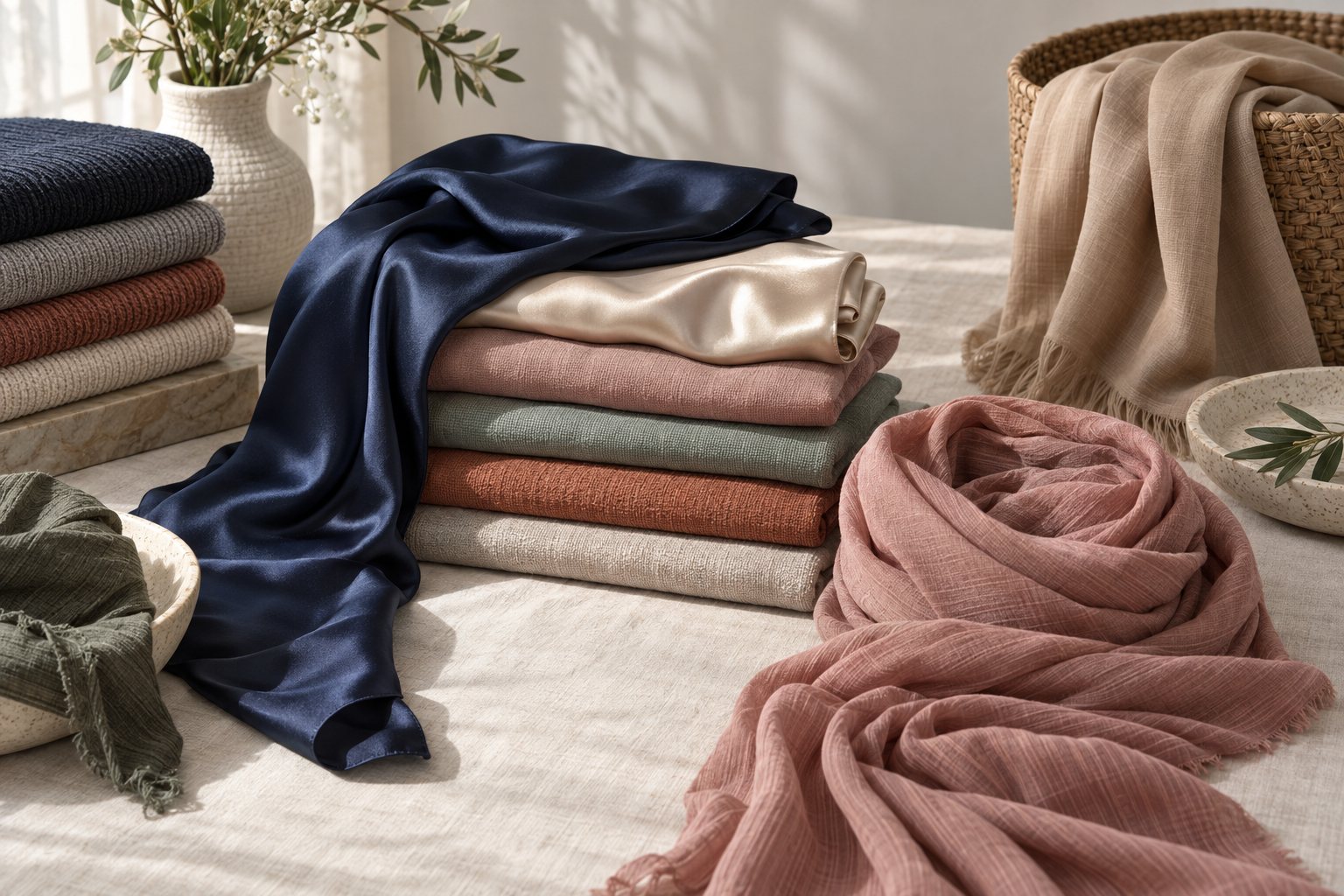
The occasion hijab
Weddings, Eid, evening events and gift sets bring a different kind of order. Customers want sheen, a fluid drape and colors that read as special: ivory, champagne, deep jewel tones. Satin and silk deliver that look. They also bring three practical issues: they slide, they mark and snag easily, and the word "silk" is used loosely in this category in ways that do not survive a label check.
The first decision is fiber. Satin describes a weave, not a fiber: a construction that floats yarns over the surface to create a smooth, reflective face. Satin can be woven from polyester, silk or other fibers. Silk is a natural protein fiber that can be woven as satin, charmeuse, chiffon or crepe. A polyester satin and a silk satin can look similar across a room; they differ in hand, breathability, care and price, and they must be labeled differently.
Silk vs polyester satin
| Point | Polyester satin | Silk |
|---|---|---|
| Fiber on the label | Polyester | Silk |
| Sheen | Bright, even | Soft, deep |
| Hand | Smooth, cooler, slippery | Smooth, warmer, fluid |
| Breathability | Lower | Higher |
| Crease and color | Holds color well, resists creasing | Marks and creases more easily |
| Care | Gentle wash in many cases | Often hand wash or dry clean, per care label |
| Cost position | Accessible | Premium |
Most satin hijabs in wholesale ranges are polyester. Silk hijabs are a smaller, premium line, and the supply and pricing differ accordingly. Both are quoted per program from the spec sheet.
Labeling honesty: what "silk" can mean on a label
In the United States, the label states fiber content by generic name and percentage, together with the country of origin and the name or RN of the responsible company. A polyester satin hijab is labeled polyester, whatever it looks like. Terms such as "silk-feel", "silky" or trade names that contain the word silk do not change the fiber, and product pages should not let them imply silk. Medina silk, for example, is a trade name for a matte polyester crepe and is labeled polyester.
If a hijab is described as silk, the fiber content on the label, the mill documents and the product page should all say silk, with any blend stated by percentage. We ask the partner workshop for the fabric composition in writing before sampling and check the label proof against it. For the wider rules, read hijab labeling requirements in the US.
Sheer silk and flammability
Satin is usually dense and opaque, but silk hijabs are also made in light, sheer constructions such as silk chiffon and light habotai. Clothing textiles in the United States fall under the standard at 16 CFR Part 1610, which classifies fabrics in a 45-degree flame test into Class 1, 2 or 3; Class 3, rapid and intense burning, may not be sold. The regulation notes that violative sheer rayon and silk scarves were found between 1994 and 1998, and the CPSC recalled about 375,000 sheer rayon chiffon scarves in 1995.
Keeping a satin hijab in place
Satin and silk are slippery, so they are usually worn over an underscarf, and many brands sell them as a pair. A jersey or cotton underscarf in a matching shade gives grip and hides any show-through on lighter silks. Matching a sheen fabric to a matte knit takes lab dips on both fabrics together, because satin reflects light and makes the same dye look lighter. See underscarves and caps.
Hems and handling
Satin frays readily at a cut edge and shows every stitch. A rolled or baby hem gives the cleanest edge on light satin and silk; a narrow pressed hem suits heavier satins. Thread color and stitch density are set on the spec sheet. Satin also marks easily from rough handling, pins and snags, so inspection checks the face for pulls and shading, and packing usually uses tissue or a box rather than a tight fold in a polybag.
Shade is another inspection point. Satin reflects light differently depending on the direction of the weave, so two panels cut in different directions can look like two colors. The spec sheet states the cutting direction, and inspection compares pieces under the same light against the approved sample.
Colors, prints and gift sets
Satin holds deep, rich colors well, and digital prints on satin show bright, sharp detail. Custom prints typically start from about 100 pieces per design, confirmed per fabric and print method. Satin and silk hijabs are natural centerpieces for Eid and wedding gift sets with a matching underscarf, pins and a box; plan packaging at the brief stage so it is in the same quote. See satin and silk hijabs for evening and bridal lines.
Minimums and timing
For stock polyester satin colors in standard styles, workshops typically start from about 50 to 100 pieces per color. Custom colors are usually higher, set by the dye lot; silk minimums depend on the fabric available and are confirmed per program. Custom samples take about seven working days in published examples, up to around two weeks for new prints or colors, and bulk typically takes about 25 to 35 days after approval. Occasion ranges sell ahead of Eid and the wedding season, which is also peak time for workshops, so start early. All figures are typical reference ranges confirmed in writing for each program. Send the brief through the sample request form.