
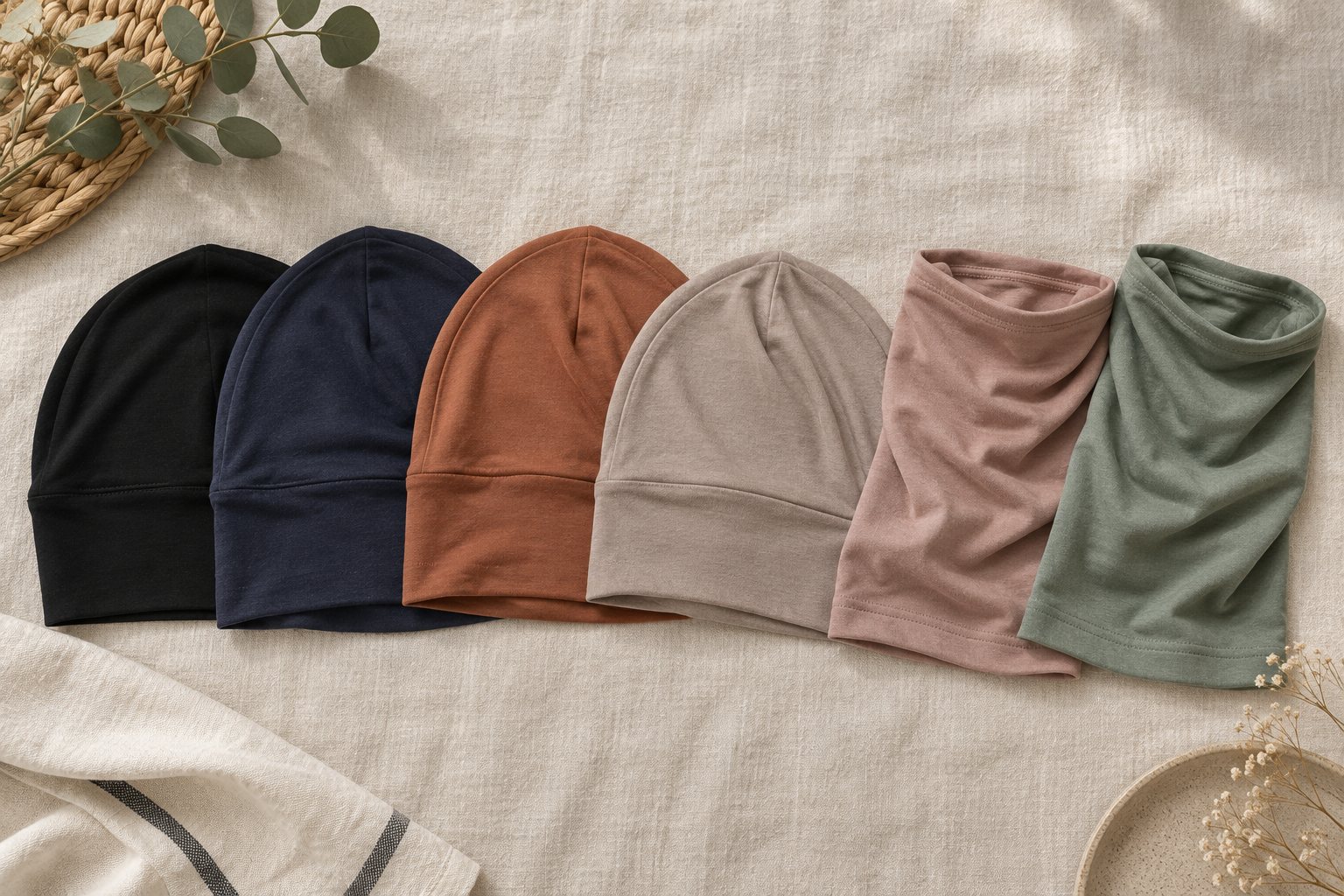
Why the underscarf matters to a range
A chiffon or satin hijab looks good and slides easily. An underscarf fixes that: a jersey layer with some grip sits close under the outer scarf, holds hair in place and gives pins something to hold. Many wearers also wear a cap on its own at home or under a hood. For a store, underscarves are a repeat purchase, bought several at a time in neutrals and in shades that match the outer hijabs. They are also the item with the most direct fit complaints, because a cap that is too tight is uncomfortable within an hour.
Cap types and how they differ
Workshops and customers use several names for the same few shapes. The table below is how we name them on a spec sheet.
| Type | Construction | Points to specify |
|---|---|---|
| Tube cap | A tube of stretch knit, open at both ends, worn as a band over the hair | Tube width, circumference, stretch and recovery |
| Tie-back cap | A front band with long ties that cross at the back and tie at the nape or crown | Tie length, how ties are anchored and finished, band depth |
| Elastic bonnet | A shaped cap with an elastic channel at the back | Elastic tension, whether the elastic is enclosed, depth |
| Full-coverage (ninja) cap | A cap with an extended neck panel that covers the neck and sometimes the chest | Neck panel length, opening size, seam placement |
| Crossover front cap | A cap with a crossed fabric detail at the forehead | Cross placement, layers, how it is stitched down |
Most ranges carry two of these: a tube or bonnet for everyday wear and a full-coverage cap for customers who want neck coverage without an extra layer.
Fabrics and grip
Underscarves are nearly always knit. Cotton jersey is breathable and matte, and its slight texture grips the outer hijab. Viscose jersey is softer and cooler, with a smoother feel. Cotton-spandex holds its shape well and keeps tension at the band, which makes it common for tube caps. The fabric choice changes how the cap feels after hours of wear, how it washes, and how much a chiffon hijab slides over it, so we sample in the fabric you intend to sell. The jersey hijabs page compares the knits in more detail.
Opacity is easy to miss. A cap that looks solid on the table can show through once stretched. We check the sewn sample stretched to its working size, and we confirm the fabric weight on the spec sheet rather than relying on a description.
Cap circumference and stretch on the spec sheet
A cap is a sized garment, even when it is sold as one size. The spec sheet records the cap circumference relaxed and the stretched measurement it should reach without strain, the depth from band to crown, and for full-coverage styles the length of the neck panel. Tolerances are written next to each measurement. Stretch and recovery are checked after a wash, because a knit that grows after washing turns into a cap that slips.
- Band tension: a band that is too firm can feel tight; a band that is too soft lets the cap ride up. We agree the target on the sample.
- Seams: seams at the forehead, behind the ears and at the nape should be flat. Covered or flatlock seams are common for these points.
- Elastic: enclosed elastic is gentler on hair and lasts longer than exposed elastic.
- Ties: ties should be long enough to tie comfortably and finished so they do not fray.
Colors and matching
Many customers match their cap to the outer hijab, or choose a neutral that disappears under it. A practical palette carries black, white, ivory, nude and grey tones across the year, and adds shades that match the season's outer hijabs. Matching a knit cap to a woven chiffon scarf is harder than it looks, because the two take dye differently. If matching sets matter to your range, plan lab dips on both fabrics together.
Labels and the flammability classification question
For the United States, caps and underscarves usually carry fiber content, country of origin and dealer identity under the Textile Act rules, and care instructions where the Care Labeling Rule applies. Under the Flammable Fabrics Act, clothing textiles are tested under 16 CFR Part 1610, but hats, gloves, footwear and interlining fabrics are exempt under 1610.1(c). Whether a specific cap or underscarf counts as a hat for that exemption is a classification question, not something the desk decides; confirm it with your compliance adviser. Opaque jersey caps are rarely the concern that sheer woven scarves are, but the classification still needs a written answer. Our compliance overview and the note on scarf flammability explain the background.
Packing and presentation
Underscarves sell well in multipacks, often three or five caps in coordinated neutrals. Packing options include a folded cap in a polybag with a header card, a multipack band, or a small box for gift sets. Barcodes, size stickers and inserts are confirmed on the spec sheet along with carton counts, so the cartons arrive ready for your warehouse.
MOQ and lead time
For stock colors in standard cap styles, workshops in the cluster typically start from about 50 to 100 pieces per color and style. Custom colors are dyed by lot and usually need more; multipacks count each color separately. Samples for stock styles ship in days, while new colors take about seven working days to two weeks; bulk typically takes about 25 to 35 days after approval, longer in the weeks before Ramadan and Eid. These are reference ranges, confirmed in writing for each program; read MOQ and lead time, then send your cap types and colors through the sample request form.