
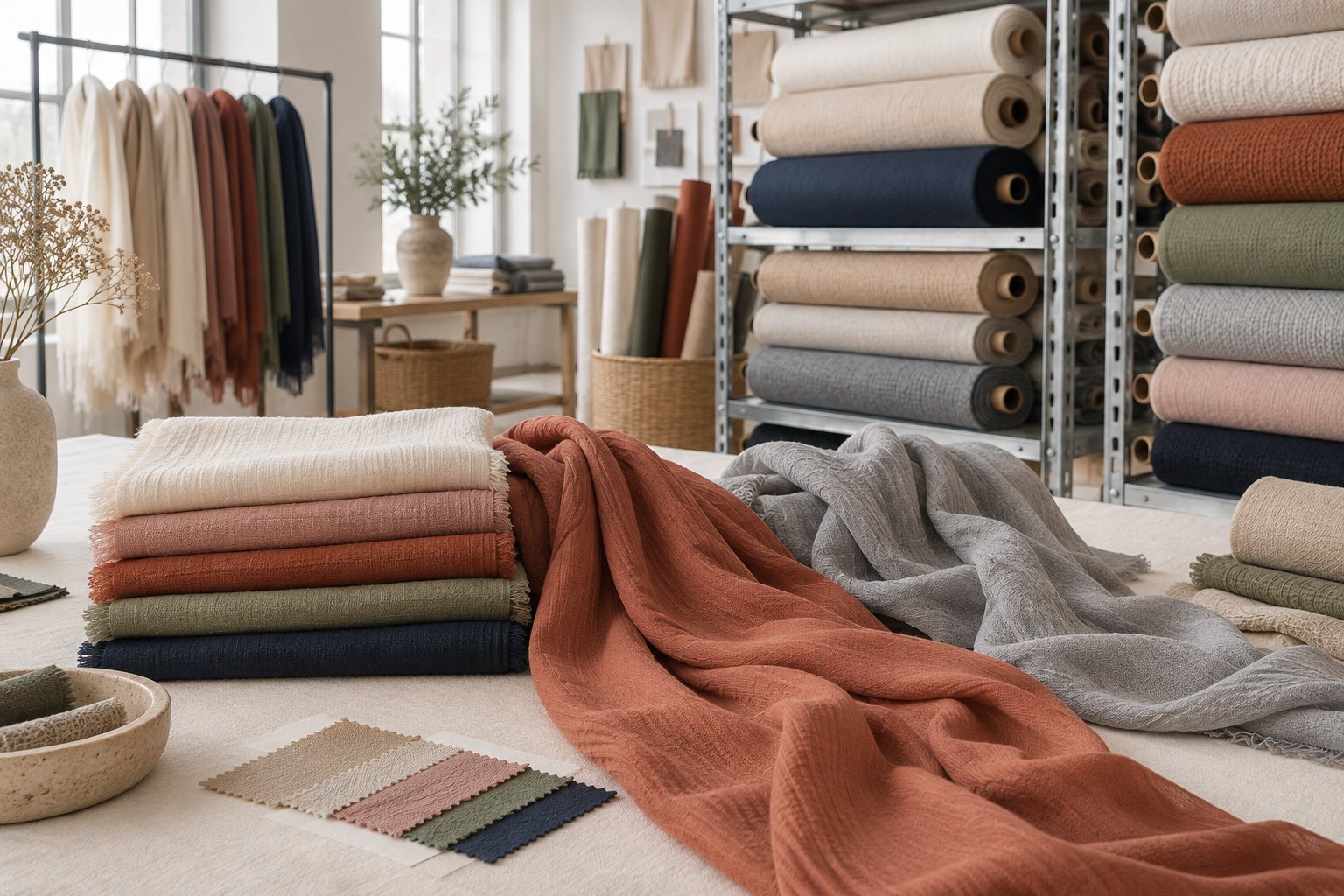
Why one workshop rarely fits every program
A buyer who has sourced one hijab line often assumes the same supplier can make the next one. Sometimes that works. More often the second line is a different fabric, a different edge or a much smaller run per color, and the first supplier either declines it, passes it to someone else without saying so, or makes it on equipment set up for something else. The result shows up at inspection: uneven rolled hems, shade drift between colors, prints that sit slightly off the edge.
The desk exists to avoid that mismatch. We keep working relationships with partner workshops across the scarf and modest-wear cluster around Yiwu, Zhejiang, and route each program to the ones that already run its fabric and finish as everyday work. You deal with one contact; the workshop does the work it is set up for.
The Yiwu cluster in plain terms
Yiwu is a large scarf and accessories trading and manufacturing hub. Its international trade market has a dedicated scarf and shawl area, and many companies in and around the city list hijab production alongside knitting, weaving, digital and screen printing and sewing. Industry sourcing reports describe Yiwu as accounting for a large share of China's scarf sales volume. We do not repeat a precise percentage, because published figures vary by source and year.
What matters for a buyer is that the steps of a hijab program sit close together. Base fabrics are knitted or woven nearby, dyed or printed nearby, then cut, hemmed, sewn, pressed and packed within the same area. That keeps sampling fast and lets a program move between specialist units when it needs to, for example printing at one site and rolled hemming at another.
Kinds of partner workshop
Workshops in the cluster range from small sewing units to integrated knit-print-sew operations. Each kind suits a different program, and none is better in general.
| Workshop type | What it usually runs | Usually suits | Watch for |
|---|---|---|---|
| Sewing and finishing unit | Cutting, hemming, pressing and packing fabric bought from mills | Stock colors, small runs, mixed styles | Fabric consistency depends on the mill lot; ask for lot details |
| Knit-and-sew workshop | Jersey knitting or sourcing, dyeing, cutting, overlock and sewn shapes | Jersey rectangles, instant hijabs, underscarves, sports styles | Stretch and recovery stated on the spec sheet |
| Print-focused workshop | Digital and screen printing on modal, chiffon, voile and satin | Custom prints, seasonal designs, squares | Strike-off approval before bulk; edge finish may be done elsewhere |
| Integrated operation | Fabric, dyeing or printing, sewing, packing under one roof | Larger programs, repeat lines, labeled retail packs | Minimums per color may be higher than at smaller units |
| Specialist sewing unit | Niqabs, khimars, prayer sets, al-amira and caps with elastic, ties or snaps | Specialist styles and sets | Pattern and measurement approval on a sewn sample |
How we match a program to a workshop
Matching starts from your brief, not from a supplier list. We read four things in this order.
- Fabric. Knit or woven, fiber and finish. A workshop strong in jersey is not automatically strong in chiffon. See the fabric guide for how the families differ.
- Finish. Overlock, rolled hem, pressed hem or laser cut; sewn shapes with elastic or ties. Rolled hems on light chiffon need experienced operators; sewn caps need tested patterns.
- Color and print. Stock colors, custom colors dyed to a reference, or custom prints. Print method narrows the field quickly.
- Quantity per color or design. A run of many colors in small depth suits a different workshop than a long run in a few colors.
Where a program needs two kinds of work, for example a printed modal rectangle with a rolled hem, we may split it between a print workshop and a finishing workshop. When we do, the spec sheet names both steps, and inspection covers the handover so a problem cannot fall between them.
What a workshop profile contains
For confirmed programs, and for serious enquiries that need it, we share a profile of the partner workshop proposed for your program. The profile describes what the workshop does, so you can judge the fit yourself. Figures in it are provided by the workshop on request; we do not estimate or round them on the workshop's behalf.
| Profile field | What it covers | Source |
|---|---|---|
| Processes run in-house | Knitting, weaving, dyeing, printing, cutting, hemming, sewing, packing | Provided by the workshop on request |
| Processes sent out | Steps handled by another unit, such as printing or laser cutting | Provided by the workshop on request |
| Fabrics run regularly | Jersey, chiffon, modal, voile, satin, crepe and others | Provided by the workshop on request |
| Edge finishes offered | Overlock, rolled hem, pressed hem, laser cut | Provided by the workshop on request |
| Staff, machines and output | Headcount, equipment and typical monthly capacity | Provided by the workshop on request |
| Test reports and certificate numbers | Reports or certificate numbers held by the workshop or its mills | Provided by the workshop on request; verified by you or your adviser |
Visits, audits and staying informed
For confirmed programs we can arrange a visit to the partner workshop or a third-party audit. Some buyers prefer to see the workshop before a first order; others rely on inspection reports and photos at each stage. Either way, the profile and the spec sheet are the documents everything is checked against.
Workshops change over time. Staff move, equipment is replaced, a unit takes on more work before Ramadan and Eid. We keep notes on how each program ran, and if a workshop that suited your last order is no longer the right fit for the next one, we say so and propose an alternative before sampling, not after.
What this means for minimums and timing
Because programs are matched by quantity as well as fabric, minimums follow the workshop and the fabric rather than one house rule. For stock colors in standard styles, workshops in the cluster typically start from about 50 to 100 pieces per color. Custom colors are typically higher, often set by the dye lot. Custom prints typically start from about 100 pieces per design. All of these are typical reference ranges, confirmed in writing for each program; the MOQ and lead time page explains how they add up.
If you are comparing suppliers or planning a first order from China, our sourcing walkthrough sets out the questions worth asking any workshop. When you are ready, the sample request form collects the fabric, finish, colors and quantities we need to propose a workshop match.