
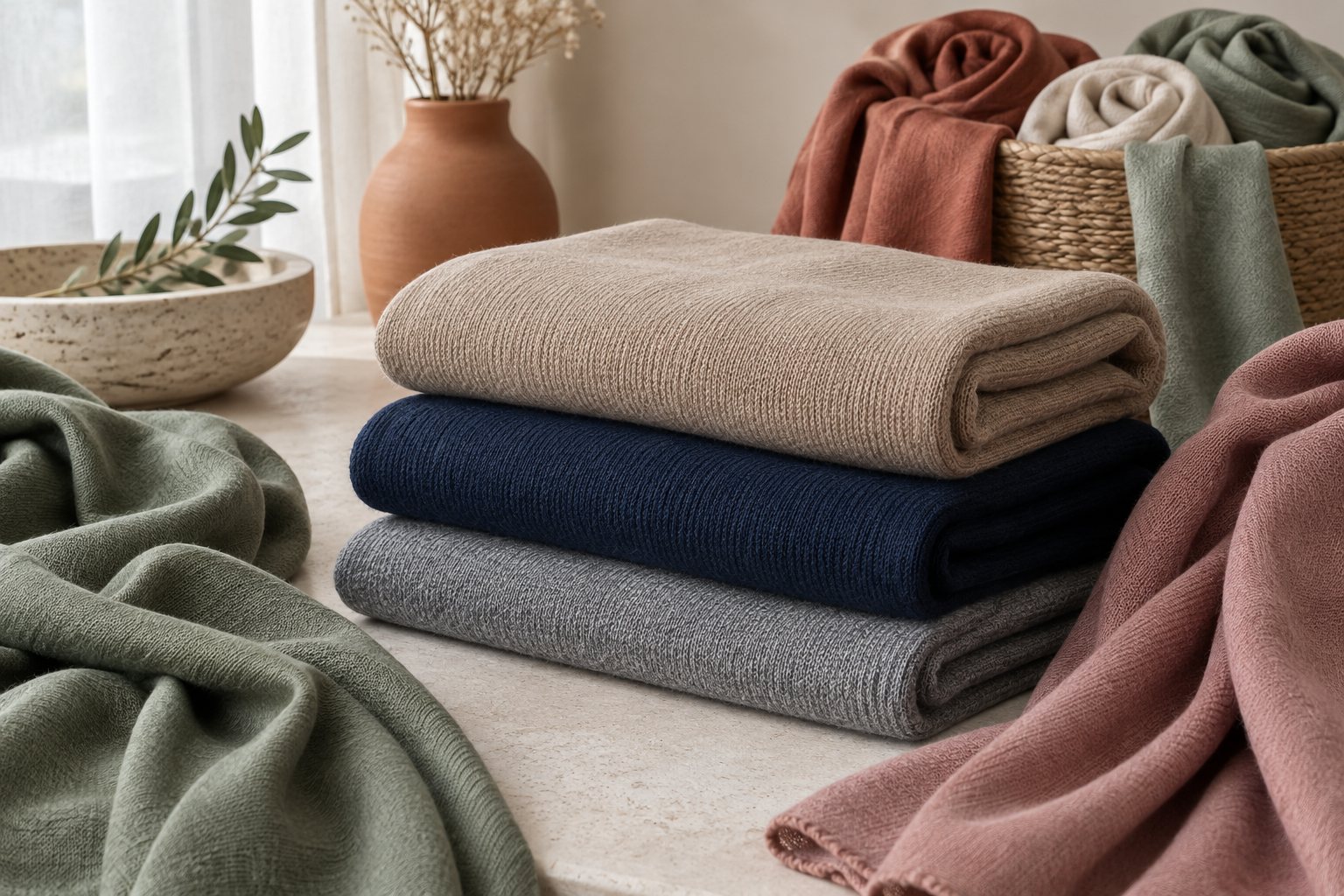
Why buyers start with jersey
Ask a store owner which hijab reorders without fail and the answer is usually a jersey rectangle in a neutral color. A jersey hijab grips the underscarf, needs few pins, covers well at most weights and forgives a quick wrap on a busy morning. It is the fabric many wearers reach for every day, and it is the base for the slip-on styles that sell on convenience.
Jersey is a knit, not a weave. It is made on circular knitting machines, which gives it stretch across its width and a soft, slightly textured surface. The same construction that makes it easy to wear also creates the issues buyers need to manage: shrinkage, pilling, edge curl and color variation between knitting lots. All of them are manageable when the spec sheet is clear.
Types of jersey for hijabs
| Jersey type | Character | Typical uses | Watch for |
|---|---|---|---|
| Cotton jersey | Matte, breathable, soft | Everyday rectangles, underscarves | Shrinkage if not pre-treated |
| Viscose jersey | Fluid, cool hand, slight sheen | Premium rectangles, instant styles | Shrinkage, pilling with friction |
| Cotton-spandex | Stretch with recovery | Underscarves, caps, kids' styles | Spandex share stated on the label |
| Bamboo-derived viscose jersey | Soft, fluid knit | Premium jersey lines | Must be labeled viscose or rayon from bamboo |
| Performance jersey | Light, quick-drying stretch knit | Sports hijabs | Fit, seam comfort, fiber content |
Most ranges need only one or two of these. A cotton or viscose jersey rectangle covers everyday wear; a cotton-spandex blend covers caps and underscarves where recovery matters more than drape. Performance jersey belongs in a separate sports program; see sports and swim hijabs.
What a jersey hijab is used for
Rectangle jersey hijabs are wrapped and pinned like any shawl, but they hold the shape with fewer pins because the knit clings to itself and to the layer underneath. Instant hijabs use jersey because the sewn shape needs stretch to slip on and settle. Underscarves and caps use jersey because they must hold hair firmly without pressure points. Sports hijabs use performance jersey because it moves with the wearer and dries quickly. If your range includes slip-on styles, read instant hijabs for the construction details that go on the spec sheet.
Opacity and weight
Jersey is opaque at most weights, which is one reason many wearers choose it. Light jerseys can still show through in strong daylight, especially in pale colors. Rather than set one weight for every program, we confirm the weight on the spec sheet against a sample you have handled, and we check opacity in daylight over a dark backing before approval. If opacity is a priority for your customers, say so in the brief and we will sample two weights side by side.
Edge finishes on jersey
Jersey edges tend to curl, so the finish matters more than on most wovens. Overlock is the most common: durable, quick and flexible, it follows the stretch of the knit. Some knits can be laser cut, which leaves a flat, stitch-free edge that sits smoothly at the face; whether a specific jersey cuts cleanly is confirmed on a sample. A turned and stitched hem gives a heavier edge suited to some instant styles. The chosen finish is written on the spec sheet and checked at inspection, along with seam strength on sewn styles.
Shrinkage, pilling and color lots
Cotton and viscose jerseys can shrink in the first wash if the fabric was not pre-treated. We ask the partner workshop to confirm the treatment and run a wash test on the approved sample, so the finished size after washing is known before bulk. Pilling comes from friction, usually at the back of the neck or under a bag strap; fiber, yarn and finish all affect it, and a pilling check belongs in the sample approval. Color can vary between knitting and dye lots, so programs with many reorders keep a master shade standard and compare each lot against it. For more, read hijab pilling and snagging.
Labels for jersey hijabs
For the United States, the label states fiber content by generic name and percentage, country of origin and the name or RN of the responsible company. Cotton-spandex blends list both fibers with their shares. Bamboo-derived jersey is labeled as viscose or rayon from bamboo, not as bamboo, under FTC rules. Care instructions follow the care labeling rule where it applies to the item; whether a given scarf or cap is covered is a classification question for your compliance adviser. Knitted scarves are usually classified differently from woven ones at customs, so the construction on the spec sheet should match the goods; your customs broker confirms the classification.
Minimums and timing
Jersey is one of the easier fabrics to start with. For stock colors in standard styles, workshops in the cluster typically start from about 50 to 100 pieces per color. Custom colors dyed to your reference are usually higher, often set by the dye lot. Stock samples ship in days; custom samples take about seven working days in published examples, up to around two weeks for new colors. Bulk typically takes about 25 to 35 days after sample approval, longer in the weeks before Ramadan and Eid. Every one of these is a typical reference range, confirmed in writing for each program. Details are on MOQ and lead time.
What to send with a jersey brief
- Style and size: rectangle, instant or underscarf, with the dimensions you want.
- Fiber preference: cotton, viscose, cotton-spandex or bamboo-derived viscose.
- Colors by reference, and quantity per color.
- Edge finish, label content and packaging.
- Any reference sample whose stretch or opacity you want to match.
Send it through the sample request form. The first reply names a jersey, a sampling plan and the questions still open.