
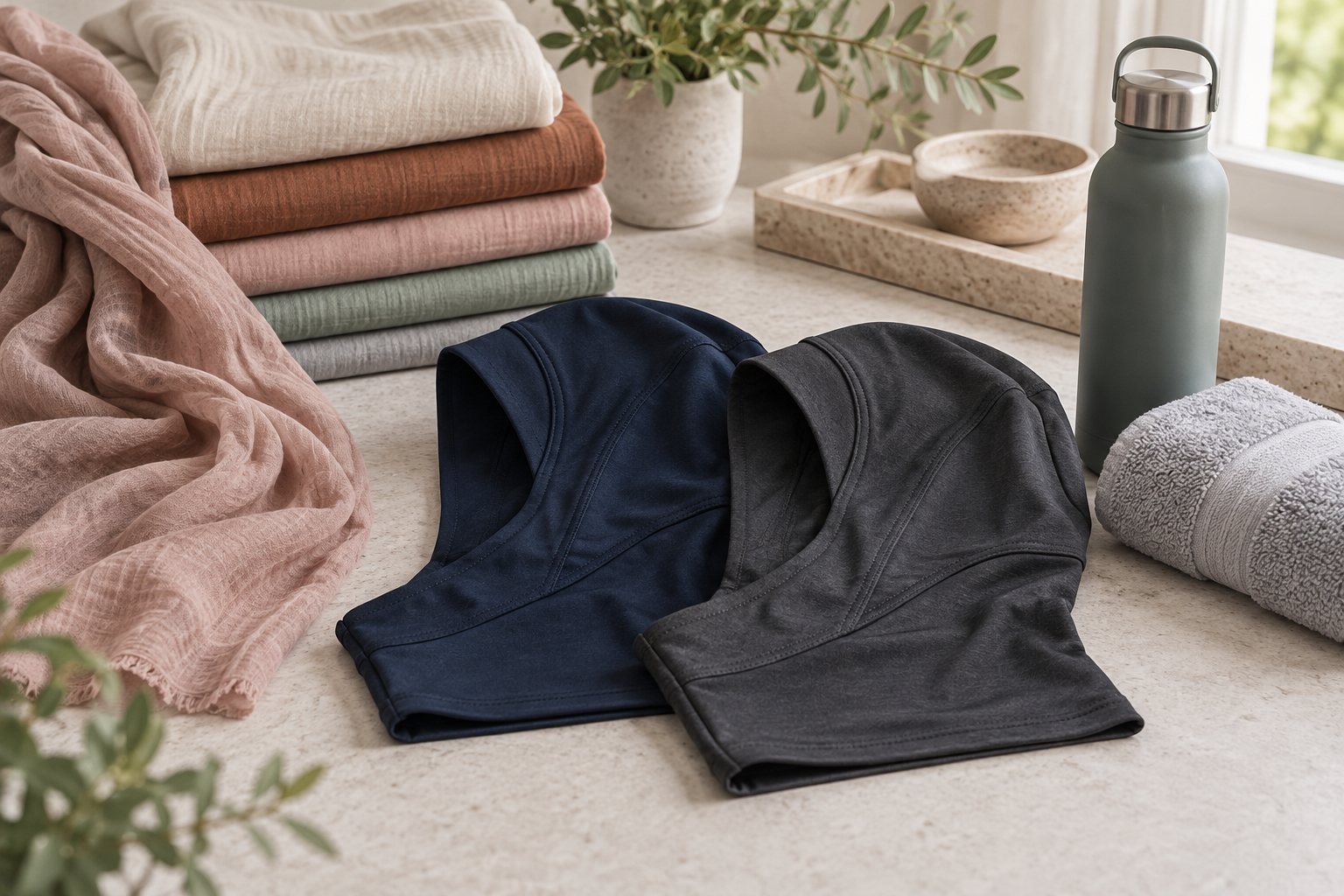
What buyers need from a sports hijab
A wrapped and pinned scarf is not built for sport. Pins can be a hazard in contact, loose ends catch, and fabric shifts during movement. A sports hijab replaces all of that with a pull-on shape in a stretch knit: no pins, no tails, a close fit at the front and a longer back and neck section that stays tucked into a top or kit. Many wearers use one for the gym, running and team training; schools and clubs add them to uniforms so players have an option that matches the kit. Some sports bodies set their own rules on headwear in competition, and those rules vary by sport and organization, so team buyers should check with the relevant governing body.
Constructions
| Construction | Description | Typical use |
|---|---|---|
| One-piece pull-on | A single knit hood with a fitted front and a longer back | Training, gym, running |
| Two-piece | A separate cap under a tube-style outer layer | Customers who want an extra layer or adjustability |
| Short neck style | Shorter back and neck section that tucks into a collar | Team kits, court sports |
| Long cape style | Longer panel covering the neck and chest | Customers who want more coverage during exercise |
| Swim hijab | Pull-on in swim knit, sometimes with a separate cap | Swimming, beach, water sports |
Performance knit for sport
Sports hijabs are made in performance jersey: knits with good stretch and recovery that move moisture away and dry faster than plain cotton. Polyester and nylon blends with elastane are common, chosen for how they feel against the forehead and how they hold shape after repeated washing. Breathability, weight and opacity are confirmed per fabric on the spec sheet, and the sewn sample is checked stretched, since thin performance knits can become see-through at working stretch. The note on breathable hijab fabrics compares the options.
Seams matter more here than on everyday styles. Under a helmet or during repetitive movement, a raised seam rubs. Flatlock or bonded seams at the forehead and around the ears are worth specifying, and labels are best printed or placed where they will not rub.
Swim fabrics and chlorine resistance
A swim hijab is made in swim knit rather than everyday jersey. Swimwear fabrics vary widely in how they stand up to chlorinated pool water, sun and salt: some blends lose stretch and color quickly, while others are made to resist chlorine. We do not assume any of this from a fabric name. Chlorine resistance, colorfastness to chlorinated water and stretch recovery after exposure are confirmed per fabric, in writing, and the test results are shared with you before bulk. Opacity when wet is checked on the sample, not on dry fabric.
Fit and safety notes for team programs
- No hard parts: sports hijabs for contact sports avoid pins, magnets, snaps and hard trims.
- Secure fit: the front band should hold without pressing; we agree tension on the sample with a wear test.
- Sizes: team programs often need two or three sizes, plus junior sizes for youth teams. Youth sizes for children 12 and under follow children's product rules; see kids' hijabs.
- Visibility: where a club wants a visible color for training outdoors, the shade is matched to the kit reference.
Team and club programs
Schools, clubs and workplaces with sports teams usually want three things: a hijab in the team colors, a logo or crest, and a reorder path for new players each season. Colors are dyed to the kit reference, with a lab dip approved before bulk. Logos are usually applied by heat transfer or printed onto the knit; placement is kept away from seams and stretch zones so the mark does not crack. For larger programs or printed patterns, see custom printed hijabs. The guide to hijab uniform programs covers sizing runs and reorders.
Building a retail sports line
Activewear stores and modest-fashion brands usually start with one pull-on style in two lengths and a short palette: black, navy, grey and white, plus one or two brighter shades that match current activewear. A swim hijab is often added as a second line once the sports style sells, sometimes alongside matching swim tops sourced separately. Product pages work best when they state the fabric, the lengths in centimeters and the care instructions plainly, and describe what the garment does rather than what the wearer should do. Photographs can show the hijab on a form or folded flat, without faces. Reorders are simpler when the same fabric and dye references are kept from season to season, so we record them on the spec sheet for the next order.
Labels and compliance
For the United States, sports and swim hijabs generally carry fiber content by generic name and percentage, country of origin and dealer identity, plus care instructions. Swim fabrics often need specific care wording, such as rinsing after pool use, which is agreed on the spec sheet. Whether a particular style is treated as headwear for any exemption is a classification question for your compliance adviser.
MOQ, samples and timing
Stock colors in standard sports styles typically start from about 50 to 100 pieces per color and style at workshops in the cluster. Team colors dyed to a reference are usually higher, by dye lot, and logo programs add a sampling step. Samples for new colors take about seven working days to two weeks, and bulk typically runs about 25 to 35 days after approval. Allow extra time for swim fabric testing. These are reference ranges, confirmed in writing for each program on the MOQ and lead time page. For school or club programs, plan around the start of the season rather than the order date.
Send your sport, sizes, team colors and logo files through the sample request form, and the first reply will name a fabric, a test plan and the sampling steps.